

Forestry waste is converted to an industrial heating oil with a carbon intensity 95 percent lower than traditional heating fuels. Global Partners will be distributing it throughout New England in just a few years.
First there was heating oil. Then biofuels and Bioheat®. Then renewable diesel. Now, coming soon, renewable fuel oil (RFO).
Renewable fuel oil is not really all that new. Ensyn Corporation patented “rapid thermal processing” (RTP) – also known as pyrolysis – more than 30 years ago, and the core RTP technology has been applied for the production of food ingredients, chemicals, and heating fuels. Ensyn markets its renewable heating fuel as RFO® in the U.S., and as Low Carbon Fuel Oil (LCFO) in Canada. It is, however, still relatively unknown in the States, outside of hospitals, colleges and other industrial facilities on the border.
That will all change when the new RFO plant using Ensyn technology is completed in Millinocket, Maine, in 2028. The facility will convert sustainably sourced forest residuals from Maine’s working forests into renewable liquid fuel capable of helping commercial, institutional, and industrial customers reduce greenhouse gas emissions while utilizing existing fuel infrastructure.
The new U.S. facility will be owned and managed by EME Biofuels, a wholly owned subsidiary of Castlerock Biofuels. In August 2026, Global Partners announced they had signed a Letter of Intent to explore marketing renewable fuel oil from the new facility. The agreement reserved Global’s right to purchase up to 100 percent of the facility’s expected annual production of renewable fuel, representing approximately 20 million gallons per year.
“We constantly explore new opportunities to bring liquid renewable fuels to the region, and this is another great opportunity that will be useful to commercial and industrial clients,” J.W. Hackett, Global Partners Senior Director, Advocacy and Public Policy, said. “We’ve looked at a lot of alternative fuels in the past, and brought renewable diesel to the region. Renewable fuel oil is another opportunity to meet the emerging needs of our clientele.”
The renewable fuel oil produced in Millinocket is expected to serve a range of end users in the heating fuel market, including commercial and institutional facilities, district energy systems, and industrial customers seeking practical solutions to reduce emissions without replacing existing energy infrastructure.
Development of the facility has reached the FEL-3 engineering stage – which defines the project scope and the designation for how much engineering has to be done. There is an approximate two-year timeline to go live. That includes construction, commissioning of all the reactors, ramp-up and training. “We expect to be up to full production within a couple of years from now,” Jeremy Akers, Castlerock Managing Director, Operations, says.
What Is Renewable Fuel Oil
The Renewable Fuel Oil that will be produced at the EME facility will use up to 300,000 green tons of forestry waste products, or “slash,” per year.
“It’s important to note that the material we use is not derived from any food source and does not impact natural harvest patterns. What is used in our process is the leftover treetops and branches after a tree is harvested for another purpose. Our process does not entail cutting down trees, but we see it as providing an extra revenue source for the forestry industry to supplement standard logging opportunities,” Akers adds.
The Ensyn pyrolysis technology super-heats the foresting byproduct in anaerobic conditions at temperatures of 500-600 degrees Celsius. Without oxygen, the material doesn’t combust, but “almost instantaneously” changes from a solid to a gas. As the gas leaves the chamber, it condenses into a liquid product which is further refined into fuel. “The RFO is basically liquid wood, and can be used for various applications,” Akers adds. The biomass feedstock is approved by the EPA under the Renewable Fuel Standard to generate renewable fuel credits known as RINs.
In addition, the facility will operate auto-thermally, as byproduct gas and biochar produced by the conversion process will be recirculated into the facility to be used as process heat.
“Pyrolysis is not new or exclusive to Ensyn,” Akers notes. “Their ‘secret sauce’ is how they design the reactor and associated components. It produces industry-leading yields into a renewable fuel, which was what we were looking for in terms of the technology to bring to the U.S.”
Renewable fuel oil is produced under ASTM D7544 for “pyrolysis liquid biofuel for use in industrial or commercial burners.” The ASTM does not include biofuel intended for use in residential heaters, small commercial boilers, engines, or marine applications.
Global Partner’s white paper on pyrolysis states that “production of pyrolysis oil helps with waste reduction, as it can serve as a diversion for municipal solid waste and agricultural waste. Compared to heavy fuel oils, pyrolysis oil may also reduce some criteria pollutant emissions. Lifecycle emissions can be significantly lowered when using waste-woody biomass as a feedstock, as EPA treats biogenic CO₂ from forest biomass as carbon neutral.”
RFO, RFS, and RINS
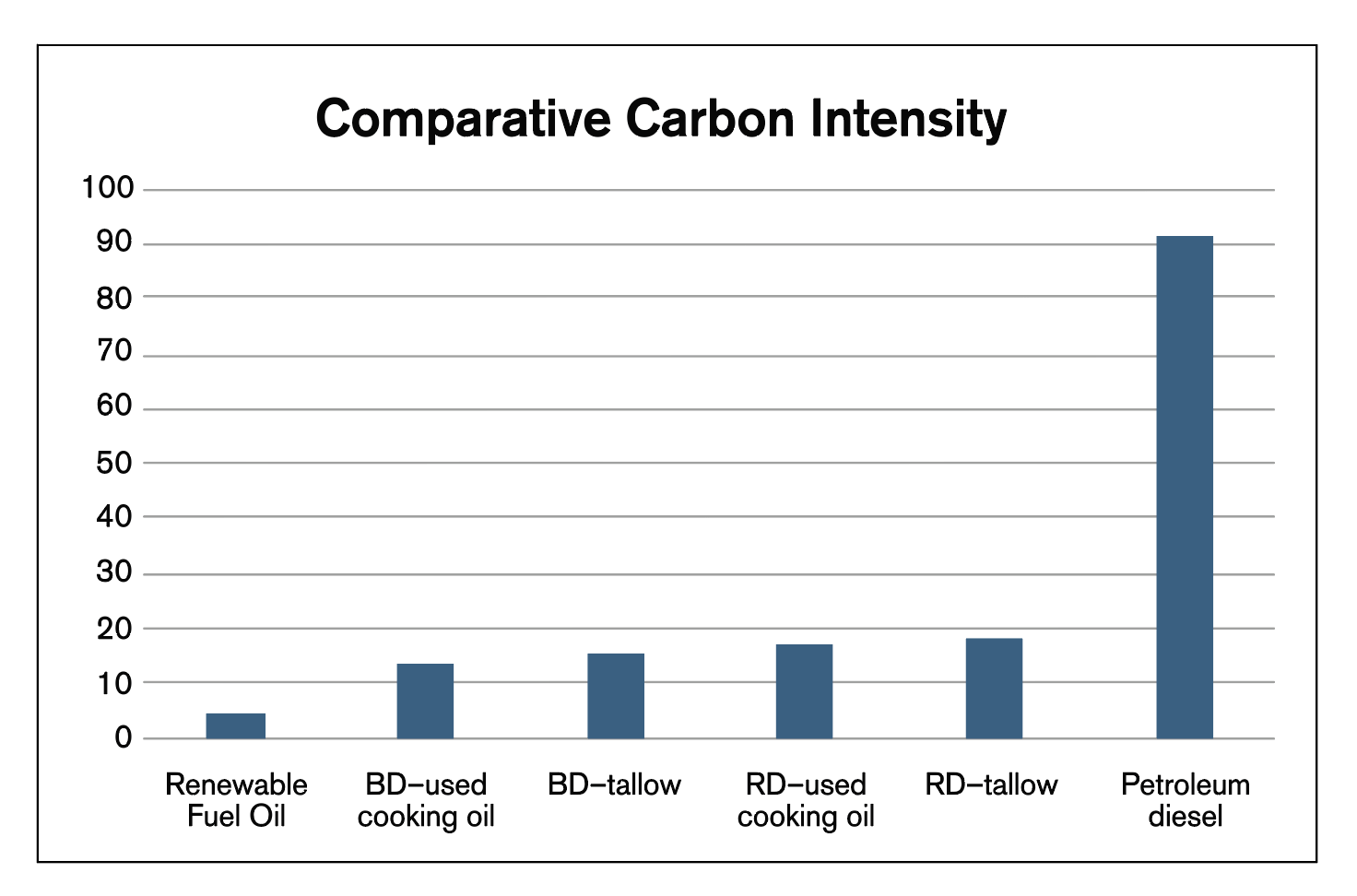
Castlerock’s third-party testing for carbon intensity determined a roughly 85-to-95 percent reduction from standard #2 or #6 oil or natural gas, with a CI of approximately 5. Akers explains that these calculations are for fuel released “at our gate” and that there may be some additional transportation emissions that will need to be added for the end-use client.
“Renewable fuel produced from Maine’s working forests offers our customers a practical way to reduce emissions while relying on the same infrastructure they use today,” Hackett said, adding, “we saw an opportunity to provide a very low carbon, locally produced fuel in areas where there may be more challenges in electrification of commercial, industrial, and institutional sites. Many of these facilities are looking to reduce their emissions. We’re excited at the opportunity to provide a product that will let companies reach a lower emissions level.”
When used for human heating and comfort, RFO qualifies for a one-to-one D7 RIN for “cellulosic biofuel that meets the criteria of both biomass-based diesel and cellulosic biofuel” with at least a 60 percent greenhouse gas reduction. Akers notes that his company is the only one currently generating D7 RINs, but these credits can be used to meet D3 requirements for “fuel derived from cellulose, hemicellulose, or lignin (e.g., renewable natural gas, cellulosic ethanol/diesel from wood, grass, or agricultural residues).”
Castlerock is looking long-term for even more recognition of its emission-reducing properties. The ArcelorMittal steel facility in Quebec is currently using the fuel to produce industrial process heat and reduce its production emissions. “You can use renewable fuel oil in the same boilers, displace the same carbon intensity as for heating. Under the RFS, if you use our fuel for human heating and comfort, you earn renewable fuel credits. But if you use it for industrial heat, it does not generate the same credits. We are looking to work with legislators to move the regulatory framework for how the fuel meets the realities of the market. In New England, a lot of industrial clients are using fuel oil. It would make sense to help these entities decarbonize,” he says. “How the fuel is used is less important than that it can reduce the use of traditional fuel oil and other high carbon energy resources for carbon reduction purposes.”
The RFO Market
Approximately two years out from being able to deliver product, Global Partners is currently educating its customers and developing interest. According to Hackett, initial plans are to deliver the 20 million gallons annually to Northern New England-based facilities. Castlerock’s announcement of the agreement added that Global’s terminal, transportation and customer infrastructure could provide a pathway for delivering renewable fuel oil throughout New England and the broader Northeast region.
Hackett is very excited about the circular economy that the product will support, as well. “Local feedstocks will be used to produce and distribute renewable fuel locally,” he points out. Keeping distribution close will also keep the transportation emissions down. Castlerock has plans to develop a nationwide network of RTP facilities, which will further reinforce the local aspect of the fuel life cycle.
With its ASTM restricting the fuel from use in the residential sector or as process heat, the audience is large facilities that require heating, such as colleges, hospitals and manufacturers. Akers notes that current customers are institutional buyers using one million gallons or more of heating oil a year.
RFO can be used in these industrial heating systems with minimal changes to the equipment.
“The Global Partners agreement is important. It pairs our planned production with an experienced downstream partner who understands the logistics. They’ve done their due diligence and understand our fuel, what it represents, and how it can fit with their clients and the market,” Akers says.
RFO and the Economy
It all comes down to the bottom line. Global and Castlerock anticipate the introduction of renewable fuel oil to benefit the end user as well as the larger community in several ways:
Job Creation: Construction of the Millinocket facility is anticipated to support approximately 200 jobs, and facility operations are expected to create approximately 80 direct full-time positions as well as additional employment throughout the forestry, transportation, and supply chain sectors.
Reduced fuel costs: The renewable fuel oil will be offers at a “known structured price point dislocated from oil and gas prices. Our input costs are forest residuals. We can offer a set and structured pricing model that doesn’t include any surprises for the customer,” Akers explains. To further clarify, he references a generic facility that uses natural gas and faces seasonal price spikes, as well as competition from data centers and overseas buyers. The RFO offers a resource dislocated from those markets.
Additional revenue streams: Hackett looks even further afield, to the greater local economy. “Another thing that’s very important. A lot of these pulp and paper sites in the forest product sector have been struggling. This is a value-added product for the economy of northern New England. This development can help spur a lot of community benefits, and Global is excited to be part of that.”
A new use for bio-based waste product. Lower energy costs. Reduced greenhouse gas emissions. Renewable fuel oil appears to be the latest in the industry’s continued path to offer a wide range of beneficial choices for the end-user.
For more information on renewable fuel oil, please contact J.W. Hackett, Senior Director, Advocacy and Public Policy, Global Partners at jonathan.hackett@globalp.com; or Jeremy Akers, Managing Director, Operations, Castlerock, jeremy@castlerockgreenenergy.com.

