
The “cap-and-invest” multistate program was supposed to move utilities toward cleaner energy production. But is it actually increasing prices and reducing investments?
The Regional Greenhouse Gas Initiative (RGGI) is one of the premier examples of a “cap-and-invest” strategy to reduce CO2 emissions, with a cooperative, multi-state, market-based effort that covers utility energy emissions across the states of Connecticut, Delaware, Maine, Maryland, Massachusetts, New Hampshire, New Jersey, New York, Rhode Island, and Vermont. RGGI has been in the news lately with the announcement Virginia will be rejoining the cooperative.
As states throughout the country are reviewing clean energy regulations and variations of cap-and-trade (or cap-and-invest) plans, the RGGI model is one worth looking at. Is it a tax in disguise that will be used by short-sighted legislators to hamper consumer energy choice and raise energy costs? Is it the route to the future, where renewable fuels play their part in a lower-carbon tomorrow? Is the cost of participating raising electricity costs, in complete opposition to RGGI’s stated goals? Does it even have the effect on emissions and technology that it was created for? There is a lot to unpack.
What is RGGI
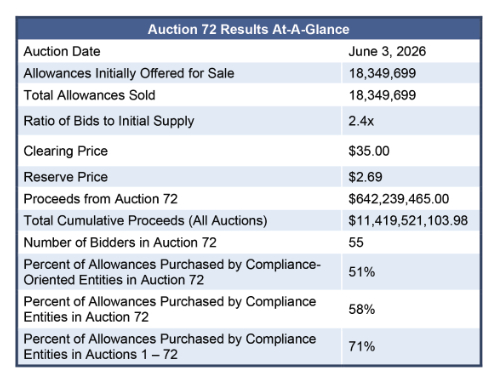
RGGI represents the first cap-and-invest regional initiative implemented in the United States.
RGGI sets an annual regional CO2 emissions cap for power plants that declines each year. Power plants with a capacity of 25 megawatts or larger must comply with the regulation. Each RGGI state issues a specific number of emissions allowances annually based on its share of the regional cap.
A CO2 allowance represents a limited authorization to emit one short ton of CO2 from a regulated source, as issued by a participating state. Under the terms of RGGI, the “regulated sources” are electric generation plants. They may use a CO2 allowance issued by any participating state to demonstrate compliance in any state. They may acquire allowances by purchasing them at regional auctions, or through secondary markets.
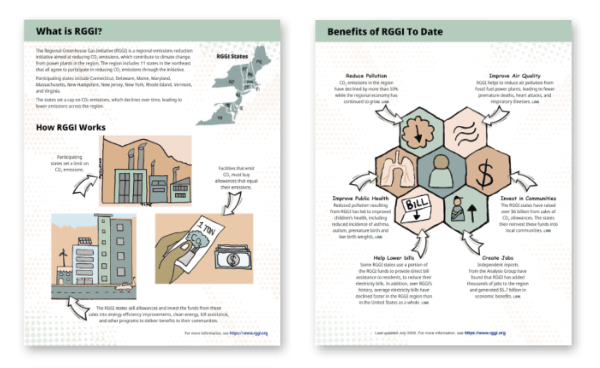
RGGI announced that 18,349,699 CO2 allowances were sold at a clearing price of $35 at the most recent auction, held June 3, 2026 (Auction 72), generating more than $642 million from 55 bidders. These funds were to be made available for states to reinvest in “strategic programs, including energy efficiency, renewable energy, direct bill assistance, beneficial electrification, and GHG abatement programs.” For many of these states, “beneficial electrification and GHG abatement programs” are mandated or heavily incentivized heat pump installations.
What About Virginia?
In the latest news – Virginia was in, then it was out … and it is back in, as of July 1, 2026. The change in status has – unsurprisingly – coincided with changes in governors … and their party affiliation.
In 2020, Virginial passed the Clean Energy and Community Flood Preparedness Act, which allowed the state to join RGGI, and officially entered the cooperative in January 2021 under Governor Ralph Northam (Democrat).
In 2023, after the state had generated approximately $827 million from the quarterly allowance auctions, Governor Glenn Youngkin (Republican) called the program a regressive tax, and the State Air Pollution Control Board voted to repeal the RGGI regulation. This repeal was fought in court, and in November 2024 the withdrawal was ruled unlawful because only the General Assembly had the authority to repeal the statute. The Youngkin administration appealed the decision.
In January 2026, newly inaugurated Governor Abigail Spanberger (Democrat) moved swiftly to drop any pending legal appeals, and in May, Virginia’s Department of Environmental Quality revised the state carbon training rules, and Virginia officially resumed participation in RGGI on July 1, 2026. Virginia does not allow governors to serve consecutive terms, so what will happen after the 2029 election is anyone’s guess.
Raising Funds, Lowering Emissions
According to RGGI, since 2005, RGGI states have reduced annual power sector emissions 50 percent, and have raised over $10 billion to invest into local communities. The states receive the proceeds from selling their RGGI allowances, and each state has discretion over how to best use their proceeds.
After the June 3, 2026 auction, those proceeds equaled:
| State | Auction #72, 6/3/26 | Total Proceeds |
| Connecticut | $36,438,570.00 | $626,634,173.00 |
| Delaware | $25,118,550.00 | $420,287,508.00 |
| Maine | $21,203,735.00 | $335,558,707.00 |
| Maryland | $115,523,940.00 | $1,922,835,026.00 |
| Massachusetts | $84,680,435.00 | $1,522,055,135.00 |
| New Hampshire | $28,875,245.00 | $28,875,245.00 |
| New Jersey | $117,306,175.00 | $1,451,116,857.00 |
| New York | $194,720,785.00 | $3,505,278,816.00 |
| Rhode Island | $14,398,405.00 | $235,218,416.00 |
| Vermont | $4,973,620.00 | $71,013,462.00 |
| Virginia | N/A | $827,721,191.00 |
As energy prices soar, many states are utilizing the funds from RGGI to lower energy costs. New Jersey is utilizing funds to increase utility rebates; New York is using RGGI dollars to cover the costs of utility programs that would otherwise be charged to ratepayers; Virginia has earmarked half of its anticipated gains toward bill rebates, estimated at $3 per month; and New Hampshire converts its RGGI funds into consumer utility bill credits. While this usage falls under the aegis of the RGGI agreement, it cuts into the program’s efficacy in reducing emissions.
In addition to the funds raised for CO2 reduction and community services, RGGI claims that CO2 emissions in the region have declined by more than 50 percent; air pollution from fossil fuel power plants has been reduced; the reduced pollution has led to improved children’s health; and thousands of jobs have been added to the region, generating $5.7 billion in economic benefits.
Too Good to Be True?
Not everyone is throwing rose petals at RGGI and its cap-and-trade structure.
One of the biggest complaints about RGGI is that it actually raising costs for consumers. In announcing Virginia’s return to RGGI, the National Propane Gas Association observed, “Notably, of the 10 states that were fully covered by RGGI in 2024, all of them had higher residential electricity rates that year than the national average.”i
Total cumulative proceeds from all RGGI auctions is more than $11.4 billion. Auction 72 in June generated $642,239,464. Each of the allowances purchased via auction authorizes the release of one ton of CO2. The money to pay for the allowances has to come from somewhere – and that somewhere is the consumers pockets.
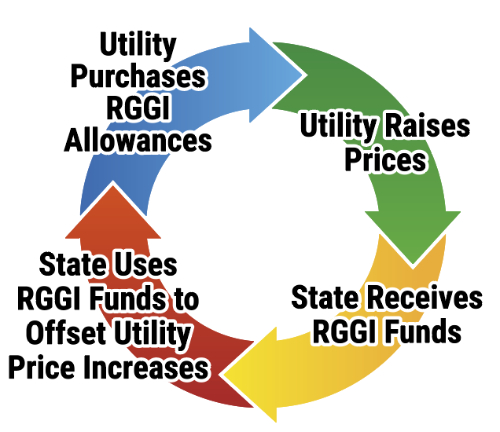
Breaking down the RGGI process to the simplest form:
Q: Who is buying the allowances?
A: Power plants or utilities that need the approval to emit carbon dioxide when producing “clean” electric energy.
Q: How do the utilities get the funds to purchase the allowances?
A: They raise consumer prices to recover the costs of the allowance.
Q: Where does the money from RGGI auctions go?
A: To individual participating states, to distribute as needed.
Q: What do the states do with RGGI funds?
A: The states use funds received through RGGI auctions to provide consumer rebates and credits to offset the higher cost of electricity caused by RGGI auctions.
Even pro-electrification sources, such as E&E News by Politico, expressed concern about pricing, after Virginia, with “the world’s densest concentration of power-hungry data centers,” rejoined. The additional demand would put additional strain on the system, inflating demand for allowances and increasing costs. “The move could add several dollars each month to home electricity bills across the northeast and mid-Atlantic,” they opined.ii
When Virginia was first part of RGGI, Dominion Energy imposed charges of $4-$5 per month on residential households, and the expectation is that those charges would be much higher now. The concern about RGGI increasing prices is so widespread throughout member states that the New Jersey Business & Industry Association (NJBIA) has launched a Rethink RGGI campaign to promote an alternative to the cap-and-trade program, where the state exits RGGI and instead charges a flat $7-per-ton fee on all generators – a much lower rate than the $35 cost of RGGI allowances in June.
New York Governor Kathy Hochul has pulled back from many of the state’s CO2 emissions-reductions deadline in an effort to keep energy costs from rising. But New York is a member of RGGI, which requires reductions from its generators. The Empire Center, comparing RGGI credits to permission slips, has opined that, “In 2025, New York RGGI-covered sources emitted 32 million tons of CO2. At an average auction price of $22.09 per ton — the price of a “permission slip” — that amounted to about $708 million. More recently, the price has reached $35 per ton, which translates into a $1.1 billion annual cost.”iii
Where’s the Clean Energy Growth?
The raison d’être for RGGI is to reduce CO2 emissions, primarily (theoretically) through funding energy efficiency improvements and clean energy programs. RGGI claims that carbon emission production dropped 50 percent in participating states. It does not say where – or how. Other reports claim that those reductions correlate with increases in emissions from neighboring states.
A study of U.S. Fortune 500 companies between 2001 and 2021, published in the National Institute of Health (NIH) National Center for Biotechnology Information in 2022, concluded that “RGGI was found significant in the short-term but not in the long-term within regulated states. Also, the RGGI has neither had a significant effect on carbon emission from electricity production nor failed to improve technical efficiency.”iv
Going further, the authors note that RGGI had a significant negative impact on green innovation (GI), “ensuring that the firms did not reduce their carbon emissions through green and low-carbon technological innovations.”v
The study outlined three reasons why RGGI failed to increase innovation and lower emissions from electricity production:
- Deployment of RGGI led to an increase of energy imports from bordering, non-RGGI states. This “emission leakage” increased output – and CO2 emissions – in non-participating states, and reduced emissions from within the RGGI state. Firms, realizing that the RGGI authority did not object to the reductions due to emission leakage, chose not to invest in expensive green innovation attempts.
- Political readiness, willingness, and/or instability that reduces the consumption of clean energy will affect corporate investments. In the period studied, firms anticipated the U.S. withdrawal from programs such as the Paris Agreement, and so shelved any GI plans.
- Participation in RGGI auctions may result in a drop in cash flow and anticipated earnings, resulting in fewer investments in research and development and a decline in the number of green technology patents.
RGGI does not directly affect the delivered fuels market, as its focus is on power generation plants. However, the rising costs for electricity will drive costs up for everyone, and the loop of utilities paying for allowances on the backs of their customers and states using RGGI funds to offset rising prices appears
unsustainable, especially in the current financial and political landscape.
i https://www.npga.org/news-resources/virginia-rejoins-rggi/
ii. https://www.eenews.net/articles/virginias-carbon-market-comeback-risks-a-multistate-affordability-crunch
iii. https://www.empirecenter.org/publications/it-is-time-to-rethink-the-regional-greenhouse-gas-initiative/
iv. Rahman, M.A., Ahmad, R. & Ismail, I. Does the US regional greenhouse gas initiative affect green innovation?. Environ Sci Pollut Res 30, 15689–15707 (2023). https://doi.org/10.1007/s11356-022-23189-0
v Ibid

