
Inside the bulk plants and engineered systems that keep propane supply reliable.
In the propane industry, success is often measured by what does not happen: no service interruptions, no safety incidents, and no equipment failures during peak demand.
To most people, propane appears simple — a container, a truck, a flame. Behind that simplicity, however, is a carefully engineered system designed to control pressure, maintain safety, and deliver reliable energy every day.
As the U.S. propane market moves through the high-inventory environment of 2026, attention is shifting away from large coastal terminals and toward the local infrastructure that keeps supply moving: the bulk plant.
With propane inventories reaching record levels in recent years, the challenge is no longer just securing supply. Instead, reliability increasingly depends on the strength of onsite storage systems and the equipment that safely manages propane once it arrives at a facility. Together, these elements form the quiet infrastructure that supports propane operations across the country.
The Bulk Plant at the Center
Bulk plants sit at the center of propane operations. Every delivery route, cylinder refill, and container fill begins at these facilities. When equipment runs smoothly, the system works almost invisibly. But when problems occur, even small disruptions can quickly affect operations.
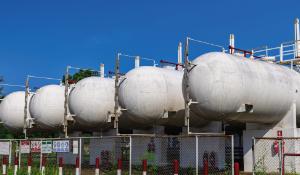
To manage seasonal demand swings, many facilities have expanded onsite storage capacity in recent years. The familiar 30,000- and 60,000-gallon containers remain the backbone of propane storage across North America.
While the overall design of these containers has changed little over time, the way they are built continues to improve. Modern containers increasingly use higher-tensile steel and advanced fabrication techniques to extend service life. One key advancement is Post-Weld Heat Treatment (PWHT), a process that relieves stress created during welding.
By reducing internal stress in thick-walled pressure containers, PWHT helps prevent cracking and fatigue over time, allowing containers to operate safely for decades despite constant pressure changes and temperature swings.
Installation methods are evolving as well. More facilities are turning to prefabricated skid-mounted systems that arrive with pumps, compressors, and piping already assembled and pressure tested. These modular systems reduce field welding and shorten construction timelines, allowing new bulk plants to become operational more quickly than traditional site-built installations.
Storage Is Only the Beginning
Although storage containers often receive the most attention, they represent only one part of a larger mechanical system.
A working propane installation relies on a network of valves, regulators, pumps, and safety devices designed to control pressure and prevent equipment failures. Service and fill valves regulate product movement throughout the facility, while pressure regulators reduce container pressure to levels suitable for downstream equipment. Excess flow and back-check valves provide protection against uncontrolled product releases, and pressure relief valves protect storage containers from over-pressurization. Pumps and compressors move propane safely through the system, enabling loading operations and product transfers.
Each component performs a specific job, but they must work together as part of a single system. A weakness in one area can affect the stability of the entire installation. For this reason, propane infrastructure is increasingly evaluated from a systems perspective, where long-term durability and consistent performance matter as much as individual technical specifications.
Layers of Protection
Bulk plant equipment is designed with multiple layers of mechanical protection to ensure that small operational problems do not escalate into larger safety incidents.
Internal valves are among the most important protective devices on a storage container. Installed directly within the container opening, they serve as the primary shutoff point and include excess-flow protection capable of stopping propane release if downstream piping is damaged.
Emergency Shut-Off Valves (ESVs) provide additional protection at transfer areas. Located near loading racks or bulkheads, these valves stop the flow of propane immediately if a hose rupture, pull-away, or transfer accident occurs. Activation can occur through pull cables, pneumatic triggers, or remote shutoff controls.
For larger containers, multi-port relief valve manifolds add another level of safety. These systems allow individual relief valves to be removed for testing or replacement while others remain active, ensuring that the container stays protected without requiring it to be taken out of service.
Accurate monitoring also plays a critical role in safe operations. Most containers use two complementary systems to track product levels. Float gauges provide a continuous visual reading of approximate container volume, while fixed liquid level gauges — often referred to as the “80 percent bleeder” — provide a physical confirmation during filling operations when the container reaches its maximum permitted level. Together, these systems help operators manage inventory while preventing overfilling.
Changing Standards and New Expectations
Operational standards across the propane industry continue to evolve.
One example is the 2026 implementation of Automatic Temperature Compensation (ATC) for new propane dispensers operating below 20 gallons per minute. Because propane expands significantly in warm temperatures, ATC systems adjust measured volumes to a standard reference temperature of 60°F. This correction helps ensure consistent measurement accuracy while protecting operational margins during the heat of summer.
Environmental conditions are also shaping infrastructure decisions. In the Midwest and Plains states, facilities are placing increased focus on cathodic protection systems to prevent corrosion caused by shifting soil moisture levels. In coastal or densely populated regions, some facilities are applying intumescent fire-resistant coatings, which expand when exposed to extreme heat and provide a temporary thermal barrier during emergency situations.
These developments reflect a broader trend across the industry: propane infrastructure continues to evolve to meet higher safety standards and operational expectations.
The Reliability No One Sees
Most propane customers will never see the systems that make their energy supply possible.
They will not notice the regulator maintaining steady pressure, the internal valve protecting a storage container, or the pump moving thousands of gallons through a bulk plant each day. Yet these unseen systems form the backbone of propane reliability.
From the steel storage containers at the center of a bulk plant to the valves and regulators that control every gallon, dependable infrastructure remains essential to safe and consistent propane delivery.
In an industry defined by pressure, safety, and performance, that quiet reliability is what keeps energy moving.
Caleb Warner is an OEM Sales Manager with Bergquist, Inc. He has more than 14 years of experience in sales and management roles across propane wholesale, transportation, retail operations, and equipment distribution. He can be reached at caleb.warner@bergquistinc.com.

