

The Eastern Energy Keynote Presentation looked at the opportunities and challenges between liquid fuels and electric heat pumps … and found they worked best together.
On Wednesday, May 20, Eastern Energy Expo presented a double-header Keynote Breakfast Session. The first, “Opportunities and Challenges Between Liquid Fuels & Electric Heat Pumps,” with an esteemed panel of home energy experts discussing the pros and cons of both heating options.
The panelists included an equipment manufacturer, renewable liquid fuel distributor, a pro-electrification legislator, two HVAC company representatives and a special guest from EuroFuels, NORA’s European counterpart. Despite the diverse outlooks, there was marked agreement about the best path for future heating systems.
The panelists for “Opportunities and Challenges Between Liquid Fuels & Electric Heat Pumps” were Dr. Ernst-Moritz Bellingen, of en2x and Eurofuel; Roger Marran, Energy Kinetics; Rep. Steven Winter, Connecticut, 94th District; Charlie Uglietto, Cubby Oil; Jeremy Flick, Apex Refrigeration, Cooling & Heating; and Kyle Hatch, R & W Heating Energy Solutions. The discussion was moderated by NORA President Michael Devine.
Each panelist was given a few minutes to introduce themselves and their connection to the topic.
- Jeremy Flick and Kyle Hatch, are each from Connecticut HVAC service providers, and have boots-on-the-ground experience working with homeowners and installing multiple heat pumps per week.
- Uglietto’s Cubby Oil not only installs heat pumps but also delivers liquid fuels, and has direct before and after comparisons of fuel use in homes that had installed heat pumps.
- Winter was elected to the 94th Assembly District of New Haven and Hamden in November 2024. Prior to that, Winter was the Climate Sustainability Director for the City of New Haven. He currently serves on the Energy & Technology, Planning and Technology, and Finance, Revenue and Bonding Committees of the State Assembly.
- Marran, as president of Energy Kinetics, provided detailed information comparing the energy efficiency and life cycles of the electricity for air-source heat pumps and liquid fuels for traditional heating systems, and discussed the best options to cut GHG emissions while keeping systems affordable and residents comfort.
- Dr. Bellingen is president of Eurofuel, which he described as “the European NORA.” His organization promotes the use of renewable liquid heating fuels for residential heating and shares best practices for hybrid heating and hot water systems.
The Takeaway
In short, the panelists agreed that even the most environmentally conscious homeowner put comfort first, and that for most, electric heat pumps did not provide enough perceived warmth (more on that below!) in frigid New England winters.
The best solution, it was agreed, was a hybrid system, with electric heat pumps providing air conditioning in the summer and heat and hot water in the shoulder seasons, but with traditional liquid fuel powered heating systems providing more efficient and more tactile warmth once outdoor temperatures dropped below freezing.
On Heat Pumps and Rebates
Several panelists noted that there has been a lot of movement toward installation of heat pumps in the last few years due to the large rebates and tax credits that were available under the Inflation Reduction Act (IRA) and state rebates. While many state rebates remain in place, many federal incentives had been paused or discontinued by the Trump administration. In fact, as this issue was going to print, the Department of Energy released guidance on High-Efficiency Electric Home Rebates (HEEHR) – originally the “Home Electrification and Appliance Rebates” under the IRA – “removing program allowances for upgrades for fuel-switching (i.e. replacement of non-electric appliances) and instead allowing rebates for upgrading HVAC and appliances only from existing electric equipment to more efficient electric equipment.”
Speaking on rebates, Uglietto noted that a majority of heat pumps in Massachusetts are being installed as replacements for air conditioning equipment. There are no rebates for central air – or heating equipment – but MassSave does offer rebates on heat pumps. “Property owners who want the rebate are installing heat pumps, but these are not heating system conversions, and the systems are not being designed for conversions,” Uglietto said.
Hatch, whose company is based in Salem, Connecticut, works homes that can be “hundreds of years old.” His customers often ask about heat pumps because of available rebates, but the homes are not set up for those systems. His approach is one of customer education, also noting that by the time the installation would have taken place, the rebate might not still be available.
Rep. Winter discussed the importance of weatherizing homes when upgrading, and his work with the state to subsidize those costs as well as for heating or cooling systems. Uglietto agreed with this, adding that his company is often called in to assess a property and install heat pumps before weatherization is completed, which could lead to an oversized system after the building envelope has been sealed. Flick noted that while sizing equipment could be a challenge, the variable speed options on heat pumps make the systems adaptable to a range of situations.
The issue is one of both comfort and efficiency. Heat pumps are less efficient as the temperature drops. Marran provided data showing that heat pumps run at lower efficiencies in real-world situations than their manufacturer ratings at all temperatures, with cold climate heat pumps having a 2.1 COP (210 percent efficiency) compared to the manufacturer-reported 4.0 COP. One of his most well received (and commented on) slides noted that the journey from natural gas supply to power plant to heat pump to output yielded a net heat pump efficiency of 76 percent, compared to a boiler’s 87 percent efficiency. This was then converted to pizza pies, with homes heated with oil-fueled boilers enjoying the larger serving.
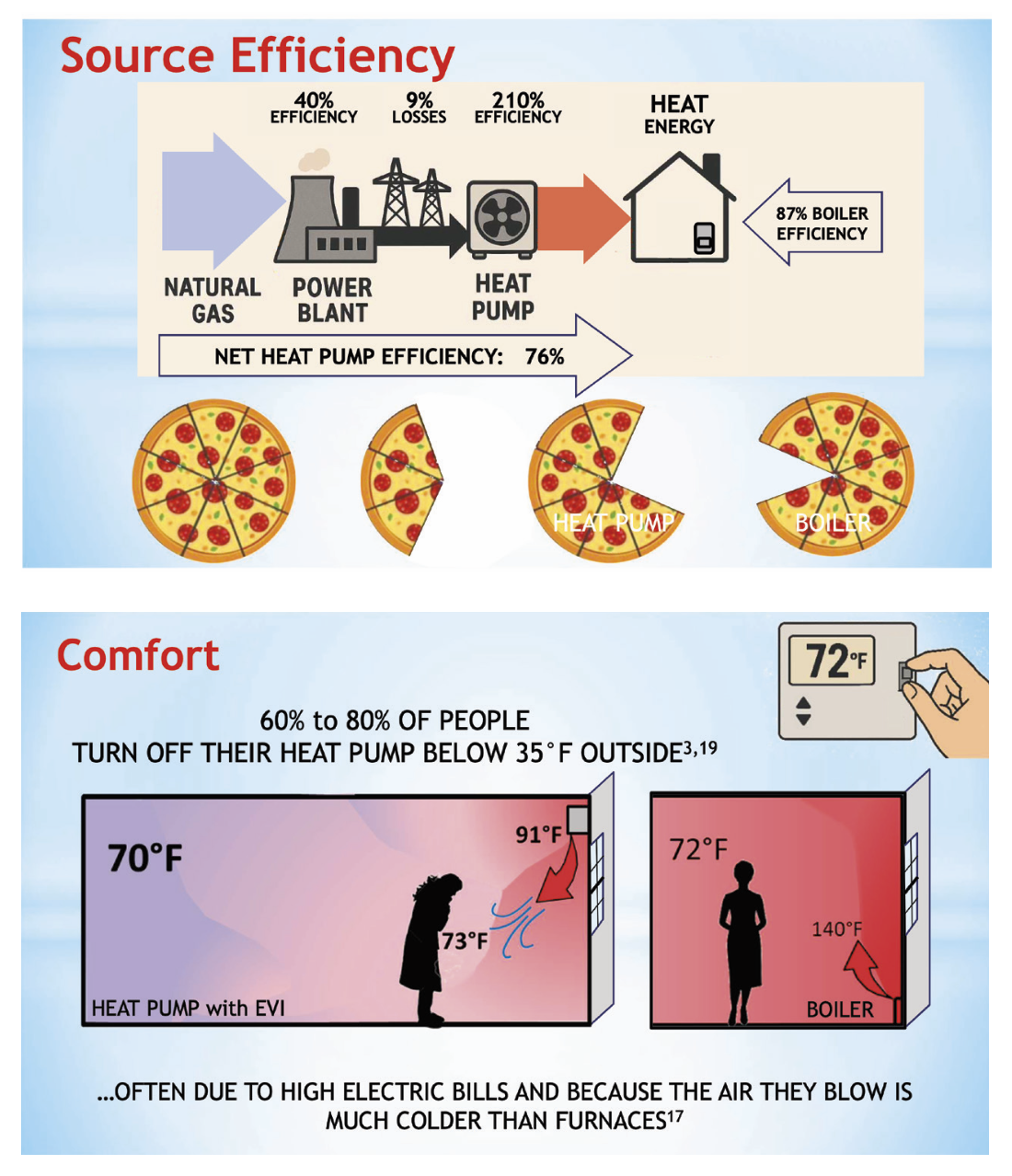
Despite the fact that manufacturers and electric heat activists recommend that hybrid systems switch to their back-up units (boilers or furnaces) when the temperature reaches 10°-20°, 60-80 percent of homeowners turn the heat pumps off when the temperature reaches 35°. The reason is two-fold: 1) the high cost of electric power and lower efficiency makes it too expensive to run; and 2) the ‘heated’ air from the heat pump is much cooler than that from a boiler.
Marran explained that air flows from a heat pump at approximately 91°F – which is lower than the average body temperature. Compare that to the heat from a radiator with water flowing at 140°F.
Uglietto also noted that his company had installed 219 heat pumps in the last three years, and that there were three areas that created both barriers – and incentives – to more widespread use.
- Cost. According to Uglietto, the cost for heat pumps in the northeast has increased 45-59 percent since 2021, along with increase in labor, insurance and other factors. The cost for other heating systems had only increased 17-22 percent. The operational costs, with electricity as high as 32 cents/kwh, become significant, especially as temperatures drop to or below freezing. Recent installations included at 4,500 sq. ft. home with 2 systems, multiple stages, and ductwork for $73,000; and a 3,150 sq.ft. home for $45,000.
- Performance. Supporting Marran’s comments, Uglietto noted that while heat pump performance is getting better, the idea of comfort is extremely important. “A heat pump that puts out 91 degree air will heat the house, but it may not feel comfortable to a lot of people. That’s what gets them to shut it off, even before the cost comes into play… Customers always ask us to adjust the switchover from 20° - to raise the switch point to a higher temperature.” He added that the homeowner who had the $73,000 installation turned his heat pump off in November because his family had been complaining about the cold – and that was before he saw an electric bill of more than $1,800.
- Repairs. Heat pump equipment has been changing dramatically each year, and repair parts are not always readily available. Customers are used to their heating technician showing up with a service van stocked with necessary parts, assessing and repairing the problem in one visit. With heat pumps, it can often take multiple visits over several days to determine the issue, order the part, and come back to complete the repair.
Bellingen, from EuroFuel, informed the gathering that of the 200 million heating systems in operation in Europe, 14 percent were heat pumps, and 8.5 percent oil fueled. However, in Germany, of 21.6 million appliances, 8.3 percent were heat pumps, and 22.5% were liquid fuels. Heat pump usage is steadily increasing, and these units are used in almost all new construction.
Furthermore, he said, In Germany – and Europe – their “eco-design directive” is currently being redesigned. Under the directive, any product placed on the market needs to meet requirements related to NOx emissions, efficiency levels, and specific turn-down ratios for oil-fired systems, which is making the systems become more complex and expensive.
Alternatively, Germany’s “New Building Modernization Act” – which he anticipated being passed by the end of June – requires that heating oil distributors must increase the proportions of renewable components in their heating oil, starting at one percent and rising in the next few years. In addition, consumers buying a heating system will be required to use an increasing volume of renewable energy, starting at 10 percent and rising to 60 percent renewables by 2040.
“The law has advantages and disadvantages,” Bellingen said. “On one hand, it makes heating oil more expensive, but on the other hand, it lays out a clear path which shows consumers that heating oil can and will become renewable. At the same time, it provides the industry with a business plan for development and production of these products.”
Renewable Liquid Fuels to the Rescue
The industries in Europe and those in the U.S.A. might not be all that different.
All the parties spoke of home heating oil, higher efficiency equipment, and renewable fuels as a path forward.
Devine, Marran, and Uglietto each referenced NORA’s field testing of 100 percent renewable fuels in their remarks (see article on page 29). Marran noted the wide availability of UL listed equipment for use with B100 or RD100 as evidence that liquid fuels must be included in any conversations about lower-carbon heating and home comfort. He also commented on the value of higher efficiency equipment, noting that an upgrade that provides 25 percent less fuel usage equates to a 25 percent reduction in emissions, and that when that upgrade is combined with a B100 fuel, the home has reduced its emissions by approximately 82 percent.
Uglietto’s company, Cubby Oil, has been active in the biofuels space since they began delivering B5 in 2008. Today, they deliver B50 company-wide, and were part of the NORA field test of 100 percent renewables. He said that the test helped them “learn a lot about how liquid renewable fuels will work. That work is critical. It allows us to reduce greenhouse gas emissions in the simplest way possible.”
“People want to do the right thing,” he continued. “They want to be environmentally conscious, but they don’t want to spend a lot of time and money to do it. They don’t want a huge lift. Liquid renewable fuels answer that.”
In Connecticut, Winter noted, the state has a graduated phase-in of biofuels in heating oil standards, currently at B10 and reaching a minimum B50 by 2035. Not mentioned specifically during the presentation were New York’s biofuel standard for space heating which reaches B20 by 2030, and Rhode Island’s B50 by 2030.
Furthermore, Bellingen noted that in today’s political situation, having an energy source stored at home makes liquid fuels one of the most secure forms of energy. “What you have in your home is yours,” he said.
Reassurance in Redundancies: Hybrid Systems
Devine opened the program commenting that there were misconceptions about each technology, and his belief that the panel could “find good pathways where we can work together to create more sustainable solutions.” He closed the individual comments portion noting that “it’s an exciting time. Consumers have good options.”
Those options, it was agreed, revolve around redundant – or hybrid – systems.
In Germany, the electric grid consists of approximately 55 percent renewable energy: more than enough in the summer, but not enough for the country’s needs in the winter, Bellingen explained. “Combining oil heating and heat pumps is an interesting option for the future. Where there is enough capacity in the grid, the heat pumps will work, but when it’s dark and windless, there’s not enough renewable energy, and so heating oil will take over.”
According to Uglietto, “I’ve always viewed our mission in simple terms: our job is to deliver comfort. We want our customs warm in winter and cool in summer.” His company installs all forms of equipment. “We come in with recommendations based on what we think is best for the customer. They trust us, because we’re supposed to be the experts.” To that end, he adds, that his company will not remove a legacy system to install a heat pump. “Any system our company installs must have a backup system.”
“This past winter was very challenging. Very cold. We had issues where heat pumps were not keeping up. But the technology is not going away. It’s here to stay,” said Flick. He also noted that his company installs five-to-ten heat pumps a week, and they advocate for hybrid systems for many reasons. “If a part for a heat pump isn’t available, you could have a customer without heat for a week or more. The back-up system keeps them comfortable.”
Hatch agreed, adding that there was a lot of customer education required with heat pumps and hybrid systems. “We do about 100 Fujitsu systems a year, both conventional and inverter heat pumps. We try to be as aggressive as possible to get as much from the system as possible, and set the balance in the high teens. We try to meet the winter specs of about 10 degrees – but heat pumps don’t have the capability to provide all the heating the customer wants.”
Winter, who works with the state to subsidize the cost of new heating and cooling systems and weatherization, acknowledged that even with cold climate heat pumps, the efficiency curve declines as it gets colder. “We look at the resident’s desires. Is the objective to reduce costs? If that’s the sole objective, most people end up with an integrated system and set the point to switch from heat pump to their legacy system based on the price of gas or oil.”
Marran also noted that with a hybrid system, the customer gets better comfort and lower operating costs; the system has a lower overall carbon intensity and lower emissions, and the hybrid set up extends the relatively short heat pump/air conditioning lifespan. “Customers are making a savvy decision in terms of financials and the environment,” he added.
Bellingen referred back to Marran’s pizza analogy when discussing what his organization is looking at regarding best practices for heat pumps and hybrid systems in Europe. “We want the whole pizza – or more than one pizza. Using only fossil fuel heating system won’t deliver the whole pizza, so we introduce alternative energy via heat pumps. But they don’t work all year. We recommend that heat pumps are run when they work best, hitting a COP of four, and stopping when they go lower. We’re looking at better technology that also combines reductions in CO2 emissions. On some days, you have more renewable electricity than on others. When we combine that with a heat pump and smart grid, the heat pump runs mostly with cheap renewable energy. We need to look at emissions and at costs, but the results should be more than a pizza! Some manufacturers are already working on these systems.
“We don’t expect heat pumps will heat the whole home in winter. By using smaller heat pumps in combination with liquid fuels heating, we can overcome energy shortages and secure supply.
So, which is the optimal heating system for the Northeast of the future – heat pumps or renewable liquid fueled systems? According to this panel, the answer is, “both.”

