
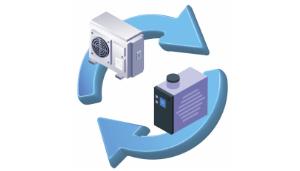
The future of home heating likely will combine multiple technologies to maximize comfort, efficiency and reliability.
The future of home heating likely won’t be all-electric or entirely fossil-fuel based. More likely, it will be balanced, resilient and adaptable — combining multiple technologies to maximize comfort, efficiency and reliability.
And that’s where boilers fit in.
A Technology That Continues to Evolve
Boilers have evolved dramatically in terms of efficiency, controls and application flexibility since the early days of the steam engine.
Today’s modern hydronic systems can do far more than simply heat a home. Modern condensing boilers are also remarkably efficient and responsive, making them ideal partners for emerging technologies like air-to-water heat pumps.
The Rise of Hybrid Heating
Hybrid systems are becoming increasingly common across many industries because they combine the strengths of multiple technologies. In a hybrid heating system, an air-to-water heat pump and a boiler work together automatically to heat the home as efficiently as possible based on outdoor conditions.
Air-to-water heat pumps extract heat from outdoor air and transfer it into water that circulates through radiant floors, fan coils or hydronic heating systems. During milder outdoor temperatures, heat pumps can operate very efficiently and handle much of a home’s heating load and, depending on outdoor temperature, can operate at two to three times the efficiency of electric resistance heat. As outdoor temperatures fall, heat pump efficiency and heating capacity begin to decline. That’s when a boiler can seamlessly take over or supplement the system.
Imagine a home in Pennsylvania during a typical winter. On a 45°F day, the heat pump may handle all of the home’s heating needs efficiently and economically. But when temperatures plunge into the teens or below, the boiler automatically steps in to maintain comfort without overworking the heat pump.
For homeowners, this approach offers several advantages:
- High efficiency during milder weather
- Reliable heating during extreme cold
- Exceptional comfort from hydronic heating
- Energy flexibility
- Reduced reliance on a single fuel source
- Greater long-term resilience as energy markets evolve
Changing the Conversation
Ten years ago, hybrid hydronic systems were largely limited to custom commercial applications. Today, they’re becoming increasingly accessible for residential installations.
A number of boiler manufacturers have released air-to-water heat pump models. Some of those units are available with turn-key kits that include everything needed to pipe and control the heat pump in tandem with a condensing boiler in a hybrid configuration.
One example is the Ambient Air-to-Water Heat Pump from U.S. Boiler Company, introduced in 2024. The five-ton Ambient system was designed specifically for hybrid heating applications and is available with a complete integration package that includes the major components required for installation. This approach helps streamline installation and ensures all components are engineered to work together as a complete system.
When combined with PV (solar electric) systems heat pumps can often heat many homes for most of the heating season, and when coupled to low temp radiant can often be used as the primary heating source with a boiler providing back-up when temperatures drop.
By combining the efficiency of an air-to-water heat pump with the proven performance and reliability of a boiler system, hybrid heating solutions offer homeowners a practical path toward greater energy efficiency and reduction in onsite carbon emissions, all without sacrificing comfort during extreme weather conditions.
A properly designed hybrid system allows the installer to determine the outdoor temperature at which the system transitions from heat pump operation to boiler operation. The result is a highly adaptable system optimized for both efficiency and comfort.
The Future is Flexible
Heat pumps are an adaptable and rapidly advancing technology, and their role in residential heating will almost certainly continue to grow. Hybrid systems are particularly attractive because they provide flexibility while existing electrical infrastructure continues to evolve. The industry may find the most benefit by viewing boilers and heat pumps as complementary rather than competing technologies.
The heating industry is entering a period of rapid change. Homeowners today are increasingly focused on efficiency, sustainability, comfort and energy resilience. No single technology is likely to satisfy every application, every home or every climate. Hybrid systems acknowledge that reality.
By combining the efficiency of heat pumps with the reliability and versatility of hydronic boiler systems, contractors can design solutions that perform well across a wide range of operating conditions.
Tom Secondino is the technical support team manager for U.S. Boiler Company and provides industry training and support on Burnham and other U.S. Boiler products.

