
High efficiency boilers remain a far more cost effective heating option than heat pumps in cold climates, and hybrid systems leverage the strengths of both systems.
Condensing boilers began gaining traction in the U.S. market in the late 1990s and early 2000s. Most early models were imported from Europe and constructed from either aluminum or stainless steel, materials commonly used overseas at the time. Aluminum, while lightweight and inexpensive, quickly revealed a critical flaw: accelerated lifecycle testing and field experience showed that aluminum heat exchangers could pit and corrode rapidly, compromising longevity and reliability. Stainless steel—specifically 316L stainless, with its superior corrosion resistance—emerged as the clear material of choice for long‑term durability.
Material selection was not the only challenge. Many traditional condensing boilers are built with narrow water passages and tight flue gas paths, making them vulnerable to fouling, clogging, and premature failure. Their control systems also change frequently, often relying on proprietary components that became difficult or expensive to source. For homeowners, a simple repair could turn into days or even weeks without heat—a serious issue in cold‑climate regions. More recently, some jurisdictions have mandated UL 1738 compliant venting, which includes polypropylene but excludes PVC. New York City explicitly prohibits PVC and CPVC for this purpose. Manufacturers also often recommend air dirt magnetic separators, which increase installation cost but significantly improve long term system reliability, especially in older homes.
Fourteen years ago, Energy Kinetics introduced the Accel CS™, a major advancement in condensing boiler design. Unlike the fragile, small‑passage heat exchangers common in the industry, the Accel CS uses a robust fire‑tube pressure vessel built with five times more stainless steel than typical condensing boilers. This pressure vessel has delivered exceptional reliability—with no reported field failures—while also offering top‑tier efficiency and comfort.
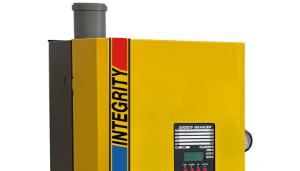
Launching this summer, the Integrity™ Combi builds on the proven Accel CS platform, emphasizing the durability and serviceability contractors value. It adds the flexibility to operate as a combi boiler—with or without a tank for domestic hot water. Available in 120,000 and 200,000 BTU models, the Integrity provides ample hot water and efficient heating for residential and light commercial applications. Its Energy Manager control supports 5 zones plus hot water with simple, self-guided setup menus, helping contractors install and configure systems quickly.
The Perfect Partner for Heat Pumps – A Hybrid Heating Solution
High efficiency boilers remain a far more cost effective heating option than heat pumps in cold climates with high electric rates, such as New England. Boilers cost significantly less upfront than whole house heat pumps, and electricity—largely generated from fossil fuel power plants—remains expensive and inefficient. Residential electricity prices average around $0.30/kWh, equivalent to roughly $12 per gallon of oil or $9 per therm of natural gas on an energy equivalent basis. As a result, boilers can provide substantially more affordable winter heating.
The annualized cost of whole house heat pump systems further widens the gap. A $30,000 system lasting 10–15 years carries a simple annualized cost of $2,000–$3,000 per year. By contrast, a $10,000 heat only boiler lasting 25 years has an annualized cost of about $400 per year. Even if operating costs were equal, heat pumps cannot overcome the $1,600–$2,600 higher annualized purchase cost.
A 2023 Department of Energy cold climate heat pump field validation study found an average seasonal efficiency of about 210 percent (COP 2.1). However, when accounting for typical New England power plant delivered efficiency of 32 percent–42 percent, the effective source to site efficiency drops sharply. Real world performance is often lower still: the study found duct losses averaging 30 percent for centrally ducted systems.
Manufacturers also recommend twice annual professional tune ups, adding to maintenance costs. Boilers, operating at 85 percent–90 percent efficiency with roughly 5 percent distribution losses, deliver higher‑quality heat and maintain comfort during frigid temperatures when heat pumps struggle—especially in older homes. Heat pumps often deliver air near room temperature, which can feel cool in winter, while boilers also provide high‑efficiency, high‑volume domestic hot water.
Using a boiler in a hybrid system is reported to extend heat pump life by several years by reducing runtime during the coldest periods. This combination leverages the strengths of both technologies: heat pumps provide efficient heating during mild weather when the grid has excess capacity, while boilers ensure reliable, cost‑effective heat during cold weather and peak demand. This makes boilers ideal as stand‑alone solutions or as partners to heat pumps, delivering reliable, efficient heat when temperatures drop.
Roger Marran is president of Energy Kinetics, Inc., a national manufacturer of innovative, high-efficiency heating and hot water systems. All Energy Kinetics heating products are manufactured in its New Jersey facility. For more information, contact Roger at rmarran@energykinetics.com.
References:
How Long Do Heat Pumps Last? Schedule tune up 2X per year. https://www.lennox.com/residential/lennox-life/consumer/how-long-do-heat-pumps-last
NYC Venting systems for gas-fired appliances; https://www.nyc.gov/assets/buildings/bldgs_bulletins/bb_2021-001.pdf
Field Validation of Air-Source Heat Pumps for Cold Climates (NREL 2023) https://docs.nrel.gov/docs/fy23osti/84745.pdf
Clean Air Markets Program Data (US EPA), New England states 10/1/2025 through 3/31/2026 with 8 percent T&D losses. https://campd.epa.gov/

