
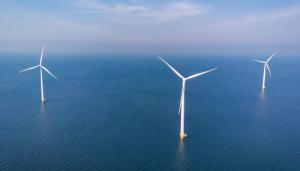
As federal policy stalls, states move forward with legislation to support wind projects.
The U.S. is projected to install 900 MW of new offshore wind capacity in 2025, a substantial increase from the 101 MW installed in 2024.
Although progress has been severely challenged by significant federal policy changes and regulatory uncertainty, the U.S. offshore wind industry has made progress this year in terms of specific project construction and state-level initiatives.
States have continued to drive progress, with at least eight states introducing legislation in 2025 to strengthen infrastructure and commitments to offshore wind, often in response to federal uncertainty.
Ongoing Construction
In the first half of the year, the Bureau of Ocean Energy Management approved several Construction and Operations Plans, aiming to approve a total of 16 by the end of 2025. It’s worth noting that the first American-flagged turbine installation vessel arrived at the Coastal Virginia project site this year. The Coastal Virginia Offshore Wind project, the largest in the U.S., is 60 percent complete and on track to begin delivering electricity in early 2026.
The Revolution Wind project (for Rhode Island and Connecticut) and the Empire Wind 1 project (for New York) both had federal “stop-work” orders issued in 2025 but later had those orders reversed, allowing construction to resume.
Significant private investments in the domestic supply chain, including manufacturing facilities and shipbuilding, continue to create jobs and build out U.S. capacity.
Major Changes In 2025
Despite project-specific progress, the industry’s long-term outlook has been significantly impacted by new federal actions that have caused widespread uncertainty.
In January 2025, the new administration issued executive actions that temporarily paused new federal offshore wind leasing and approvals, while requiring a comprehensive review of all projects.
In July and August 2025, the Department of the Interior rescinded all previously designated Wind Energy Areas on the Outer Continental Shelf, removing millions of acres from future development consideration.
Industry analysts have reduced their five-year U.S. offshore wind forecast by 1.8 gigawatts due to these policy changes and economic uncertainty.
Jobs And Local Economies
The federal policy shifts in 2025 have introducing severe regulatory uncertainty, causing project delays and cancellations, and threatening future investment.
In 2025, over $24 billion in U.S. clean energy investments and 21,000 jobs were lost. Job impacts extend beyond construction workers to related private sectors such as supply chain manufacturing, engineering, and support services.
Investments in the domestic supply chain, including $679 million for port infrastructure funding, have been withdrawn.
Project Impacts
“Stop-work” orders issued for major projects like Revolution Wind and Empire Wind 1, though later reversed, resulted in an estimated loss of several hundred people a day, with weekly losses for the companies amounting to millions of dollars.
The federal actions, including the temporary pause on new leasing and the rescinding of designated Wind Energy Areas, have discouraged future private investment in renewable energy infrastructure. Lawsuits and economic analyses estimate that leaving the policy changes in place could erase billions of dollars in direct investments across various states.
The decline in federal activity has ripple effects, reducing economic opportunities in coastal communities that anticipated an economic boost from project development, construction, and ongoing operations and maintenance activities.
State-Level Response
In response to the federal retreat, state governments have introduced legislation to try and preserve their local economic momentum and job creation through port infrastructure investments, workforce development, and state-level goals.
While specific projects with existing approvals continue to make progress, the broader federal policy shifts of 2025 have significantly hampered the potential for long-term job growth and economic development in the U.S. offshore wind industry.
On The Horizon
Floating offshore wind technology is a real game-changer. It involves mounting wind turbines on buoyant platforms that are moored to the seabed with cables and anchors, instead of fixing them directly to the ocean floor with traditional foundations.
This design allows turbines to be deployed in deeper waters (generally greater than 100 ft.) where fixed-bottom technology is not technically or economically feasible. They can now access deepwater areas far from shore, where winds are often stronger and more consistent. This is especially important for regions like the West Coast and the Gulf of Maine, where the continental shelf drops off quickly.
Turbines can be fully assembled in port and then towed out to their offshore location, reducing the need for the expensive, specialized installation vessels required for fixed-bottom projects. This technology generally causes less disruption to the seabed during installation compared to pile-driving for fixed foundations, which can mitigate noise impacts on marine life.
When will we see them? Floating offshore wind is already operational in pilot projects over in the UK, Norway, and Portugal.
The U.S. has awarded its first floating offshore wind research lease off the coast of Maine and held lease auctions in California and Oregon, specifically for areas requiring this technology. Initial projects are in planning and permitting phases, with ongoing research to drive down costs. The first commercial projects are not expected to be fully operational for several years.
The federal goal is to deploy 15 gigawatts of floating offshore wind capacity by 2035. This would be a significant increase from current capacity and a major step toward widespread use.
Ed and Kelly Burke are respectively Chairman of the Board and Senior Marketing Manager at Dennis K. Burke Inc. They can be reached at 617-884-7800 or ed.burke@burkeoil.com and kelly.burke@burkeoil.com.

