

The EIA’s March Short-Term Energy Outlook, released on March 10, analyzes the effects of the Iran Conflict on the energy landscape.
The EIA’s March Short-Term Energy Outlook, released on March 10, is the first official analysis of the effects of the Iran Conflict on the energy landscape. The following, and additional data, may be reviewed at www.eia.gov/outlooks/steo.
The forecast for Brent crude oil increased 37 percent – from $58 to $79 per gallon for 2026 – between the February and March reports. The retail diesel price forecast increased 20.1 percent, and the retail gasoline price increased 14.7 percent.
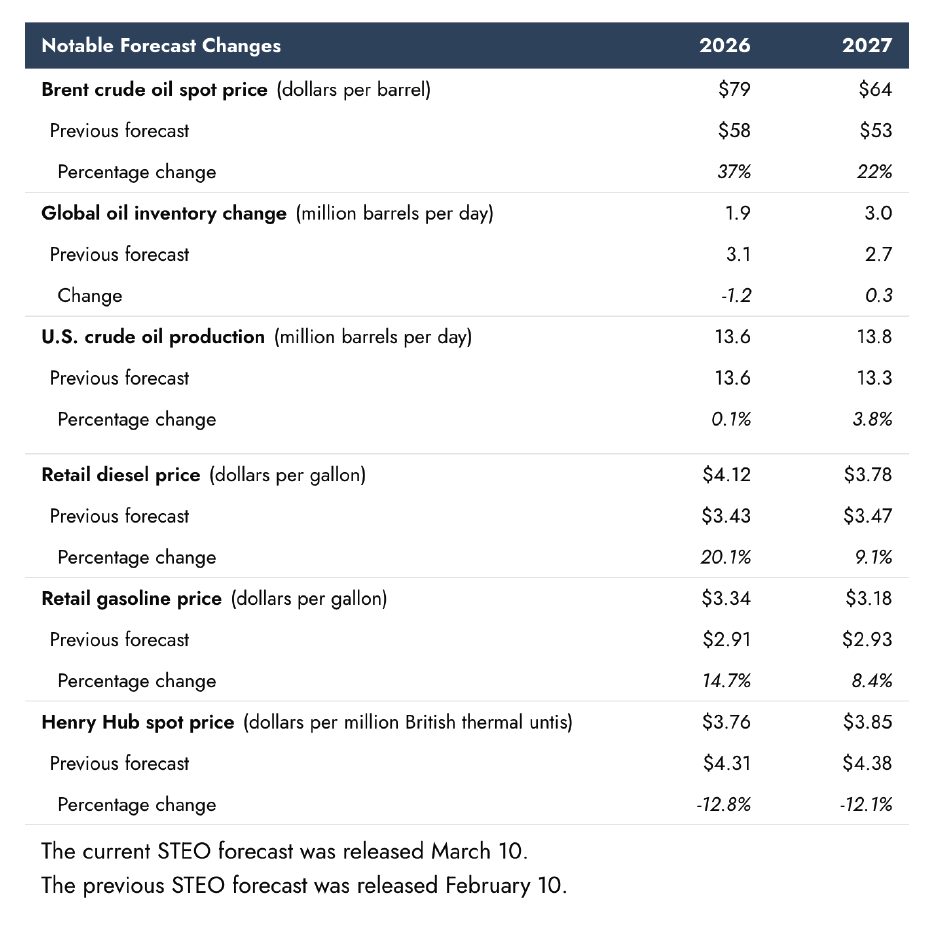
U.S. crude oil production. Higher crude oil prices lead to more U.S. crude oil production in our forecast. We expect crude oil production in the United States will average 13.6 million barrels per day (b/d) in 2026 and 13.8 million b/d in 2027. Our 2027 forecast is an upward revision of about 0.5 million b/d (4 percent) from last month’s Short-Term Energy Outlook (STEO). The West Texas Intermediate (WTI) crude oil price in our forecast is substantially higher than last month, averaging $74/b in 2026 and $61/b in 2027, compared with $53/b and $49/b, respectively, in the February STEO.
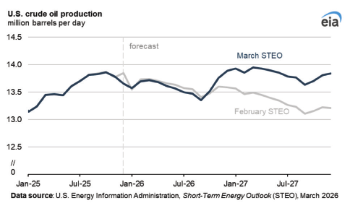
Because changes in oil prices take time to affect production—moving from investment decisions to rig deployment to well completion and first oil—the effect of higher prices in our forecast is more pronounced in 2027 than in 2026, with production increasing from 13.4 million b/d in September 2026 to 13.8 million b/d in 2027. The higher prices support increased drilling activity across most basins, and expanded pipeline capacity in the Permian region allows more associated natural gas to be brought to market, further supporting oil-directed operations. We increased our forecast for crude oil production in the Permian region by 6 percent in 2027 as new pipeline capacity and price incentives support growth.
Middle East oil production. We make the assumption in our modeling that the effective closure of the Strait of Hormuz will cause oil production in the Middle East to fall further in the coming weeks. We assume this shut-in production will gradually ease as transit through the Strait resumes.
Crude oil price movements. The Brent crude oil spot price has risen sharply following the onset of military action in the Middle East. Brent settled at $94 per barrel (b) on March 9, up about 50 percent from the beginning of the year and the highest since September 2023. Crude oil prices have risen as petroleum shipments through the Strait of Hormuz have fallen, and some Middle East oil production has been shut in. (Editor’s note: Shortly after this report was released, Brent reached more than $100 per barrel and stayed there for several days.)
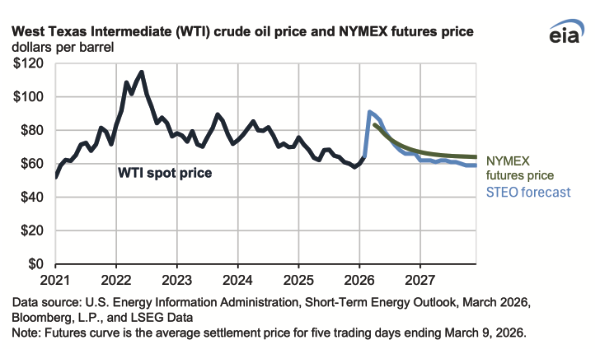
Crude oil price forecast. We forecast the Brent crude oil price will remain above $95/b over the next two months, before falling below $80/b in the third quarter of 2026 and around $70/b by the end of the year. We expect prices to average $64/b in 2027. This price forecast is highly dependent on our modeled assumptions of both the duration of conflict in the Middle East and resulting outages in oil production.
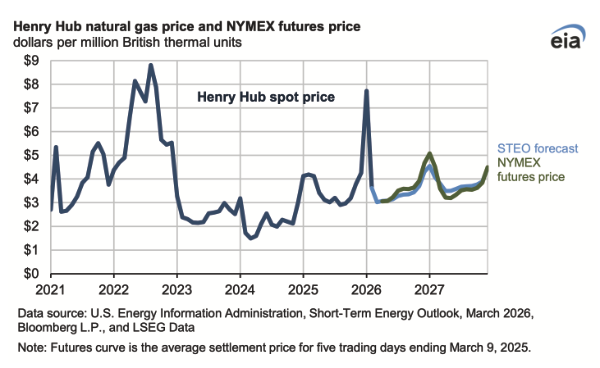
Natural gas prices. Although reduced liquefied natural gas (LNG) flows through the Strait of Hormuz have caused the price of natural gas in Europe and Asia to increase, we expect U.S. natural gas prices to be relatively unaffected by this development. In our forecast, the Henry Hub spot price averages about $3.80 per million British thermal units (MMBtu) in 20 26, or 13 percent less than our forecast last month. Prices in the early part of our forecast are lower because of milder-than-forecast temperatures in February that left more natural gas in storage than we expected. The Henry Hub spot price averages nearly $3.90/MMBtu in 2027, 12 percent lower than our forecast last month. Lower prices in 2027 mostly reflect more associated natural gas production as a result of the recent increase in oil prices and the related increase in production later in the forecast.
Natural gas production. Higher crude oil production results in more associated natural gas production. We expect marketed natural gas production to average 121 billion cubic feet per day (Bcf/d) this year, an increase of 2 percent from 2025. Production rises by an additional 3 percent in 2027 to reach 124 Bcf/d. The 2027 forecast is almost 2 Bcf/d higher than last month’s outlook.
Natural gas inventories. We expect U.S. natural gas inventories to end the withdrawal season in March around 1,840 billion cubic feet (Bcf), which is near the five-year average (2021–2025). Storage withdrawals slowed in February, as milder weather moved across much of the country, following historic withdrawals in January related to Winter Storm Fern and subsequent cold weather.
Electricity. U.S. electricity generation has been increasing by an average of 2 percent per year since 2021 to meet growing electricity demand following a period of flat demand growth between 2010 and 2019. We expect U.S. electricity generation will grow by 1.2 percent in 2026 and by 3.1 percent in 2027 led by demand growth in the Electric Reliability Council of Texas (ERCOT) region. In 2026, U.S. coal generation declines by 7 percent in our forecast as generation from renewable sources increases and the electric power sector retires about 4 percent of its coal-fired generating capacity.
Coal exports. Coal exports fell in 2025 due to a combination of low prices, weak global demand, and increased domestic consumption. Our forecast assumes coal exports will rise slightly in 2026, supported by an increase in metallurgical coal exports, as additional production capacity comes online. Disruptions to the flow of global LNG exports through the Strait of Hormuz led to an increase in thermal coal spot prices, which may support higher U.S. coal exports should LNG trade disruptions persist.

