

NORA used trade show season as a platform to reveal and discuss the results of its 18-month study on the use of 100 percent renewable fuels in oil-fueled heating equipment. The presentation “100% Renewable Liquid Heating Fuels – a Technical Success,” by Michael Devine, President of NORA, was a featured session at the Southern New England Energy Conference in September, and similar programs were offered at the Pennsylvania Petroleum Association Fall Conference and the Empire State Energy Conference.
The results could change the trajectory of the delivered fuel industry. The study’s “Conclusions” section opens with the following statement:
“This eighteen-month field study demonstrates that 100% renewable liquid fuel blends consisting of RD50/B50 and RD80/B20 can be successfully used in a broad cross-section of existing residential and light commercial oil-fired heating appliances, with few or no system modifications.”
This was not a controlled study in a pristine lab environment. In fact, NORA did everything possible to encompass as many real-world situations – and potential complications – as possible. (More on methodology below.)
The final report, “Field Study: Conversion of Oil-Fired Heating Systems to 100% Renewable Fuel,” was authored by Dr. Thomas A. Butcher, Technical Director, NORA; and Neehad Islam and Ryan Kerr, both Project Managers at NORA. These three also conducted all the research over the 18 months.
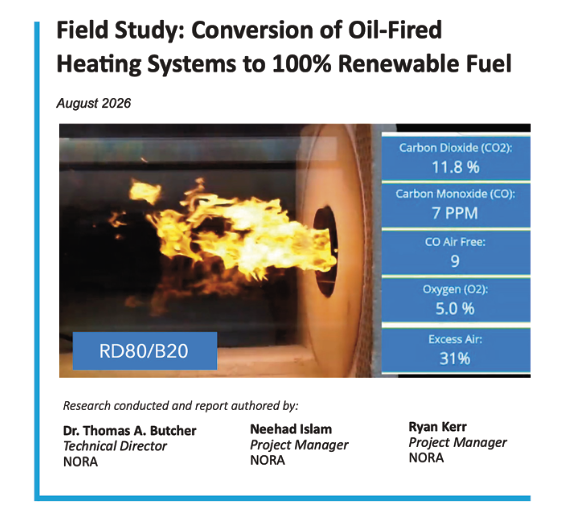
RD50/B50 and RD80/B20 can be successfully used in a broad cross-section of existing residential and light commercial oil-fired heating appliances, with few or no system modifications.
One Study, Multiple Participants
The study was co-sponsored by Clean Fuels Alliance America, which also provided supplemental funding of the project. All the biodiesel and renewable diesel – approximately 275,000 gallons – was supplied by Chevron, led by Jason Lawrence, who ensured that pricing for the fuels were kept comparable to traditional #2 distillate and/or biodiesel blends. Burner manufacturers R.W. Beckett Corp. and Carlin Combustion Technology Inc. provided technical insight and guidance.
Fuel delivery and equipment service were provided across Pennsylvania and Massachusetts by Cubby Oil & Energy, D.E. Duffey and Sons, Moyer & Son Inc., Noonan Energy Corp., Oehlert Bros. Inc., Rhoads Energy, Shipley Energy, and Wilson Oil & Propane.
Broco Energy, Rhoads Energy, and Oehlert Bros. Inc. stored and supplied the fuel in the Massachusetts, Southeastern Pennsylvania, and South-Central Pennsylvania regions, respectively.
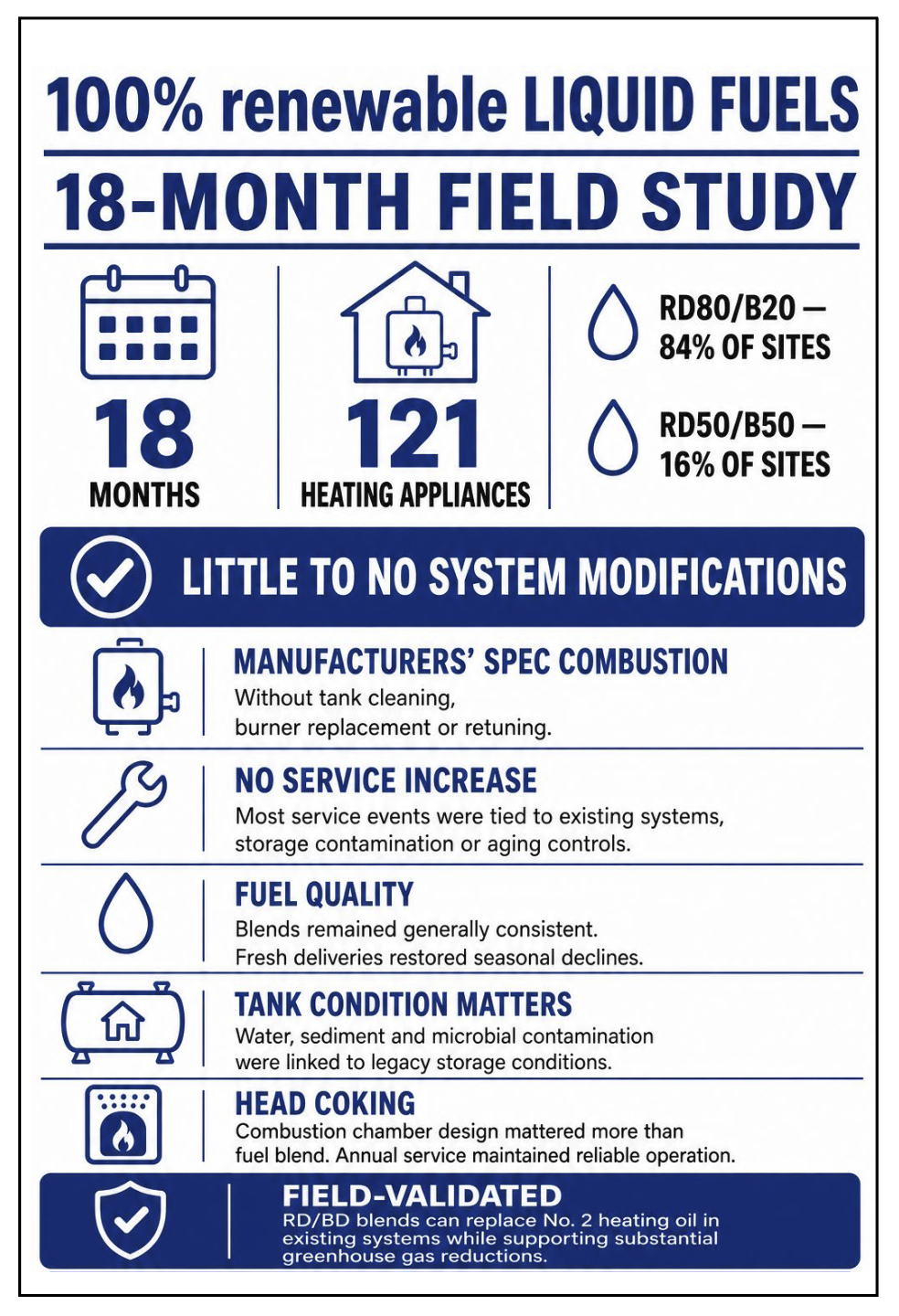
There were 121 properties that participated in the program, with 28 sites designated as Level 1 and 93 as Level 2. Level 1 sites were visited five times during the program by Islam or Kerr, along with a service manager and technician from the fuel provider, for inspection, combustion testing, and fuel sampling. Level 2 sites were only visited by the provider for deliveries or as needed/requested for service or maintenance.
Setting the Stage: 25 Years of Transformation
In the preface to the report, Devine reflects upon the past 25 years of transformation and innovation in the liquid heating fuels industry.
In the early 2000s, conventional heating oil contained between 2,000 and 5,000 parts per million (ppm) of sulfur, which contributed to emissions, heating appliance fouling, and increased maintenance. The industry banded together to dramatically reduce sulfur content, and the Northern states eventually adopted low-sulfur and ultra-low-sulfur heating oil (ULSHO), reducing the sulfur levels to 15 ppm. Devine describes this as “one of the largest improvements ever made to residential liquid fuels,” noting that ULSHO represented a 99% reduction in fuel content, produced significant reductions in sulfur dioxide and particulate emission, burned more cleanly than traditional fuel, increased the lifespan of heating appliances, and lowered maintenance costs.
Following the introduction and acceptance of ULSHO, the industry and NORA began to look into the opportunities offered by biodiesel, to determine if it could become part of the future of home heating. Years of research, creation of fuel standards, and development of biodiesel-compatible equipment and accessories would follow.
“In 2002, ASTM established ASTM D6751, creating a national specification for B100 biodiesel. Six years later came an even bigger milestone: ASTM D396, the national specification for heating oil, was revised to recognize biodiesel blends up to B5. That decision changed everything.”
“Bioheat® fuel, the brand name for the blended fuel, was no longer considered experimental; it had become part of the heating oil industry’s accepted fuel standard.”
In April 2026, ASTM standards adopted specification for B21 through B50, and manufacturers introduced UL-listed burners and boilers rated to operate on B50 and B100. “The message is clear: the science came first, standards followed, and markets grew,” Devine noted.
The adoption of the California Low Carbon Fuel Standard (LDS) in 2009 rewarded reduction in the lifecycle carbon intensity, and accelerated investment and usage of renewable diesel.
As renewable diesel continued to grow on a commercial scale, NORA recognized an opportunity to evaluate its performance in liquid fuel heating applications, both as a standalone fuel and in blends with biodiesel. Researchers at the NORA Research and Education Center in Plainview, Long Island, tested these fuels in a variety of existing heating systems. After several years of successful laboratory and controlled testing, NORA determined that a large-scale field demonstration was the next critical step in assessing their readiness for residential and commercial use.
In the Field, In Real Life: Renewable Diesel and Biodiesel Blends of Heating Oil
NORA’s Field Study—Conversion of Oil-Fired Heating Systems to 100% Renewable Fuel details the results of an 18-month field study on the use of drop-in, 100% renewable liquid fuels in 121 heating appliances in buildings in Pennsylvania and Massachusetts. The fuels include blends of 50% RD with 50% BD (RD50/B50) and 80% RD with 20% BD (RD80/B20) by volume. Test sites were selected to include a broad range of heating appliance types currently in use, including boilers, furnaces, and water heaters. Fuel storage tanks were not replaced, emptied, or cleaned prior to the start of deliveries of the test fuel. No oil burner or fuel system changes were made prior to the test. At four sites, the burner primary controls were upgraded to accommodate the lower luminosity of the RD and BD flames.
Sites were divided into Level 1 (28 sites) and Level 2 (93 sites). Level 1 sites were visited five times during the project for inspection, combustion testing, and fuel sampling. Combustion performance with the test fuel blends was within specifications based on smoke number, excess air, and CO measurements with the exception of three sites. Corrective measures were taken and the issues did not recur. Burners were not systematically retuned as part of the initial conversion; selected adjustments were made later during service or testing. When comparing burner service statistics before and after conversion to the test fuels, no increase in service requirements was found.
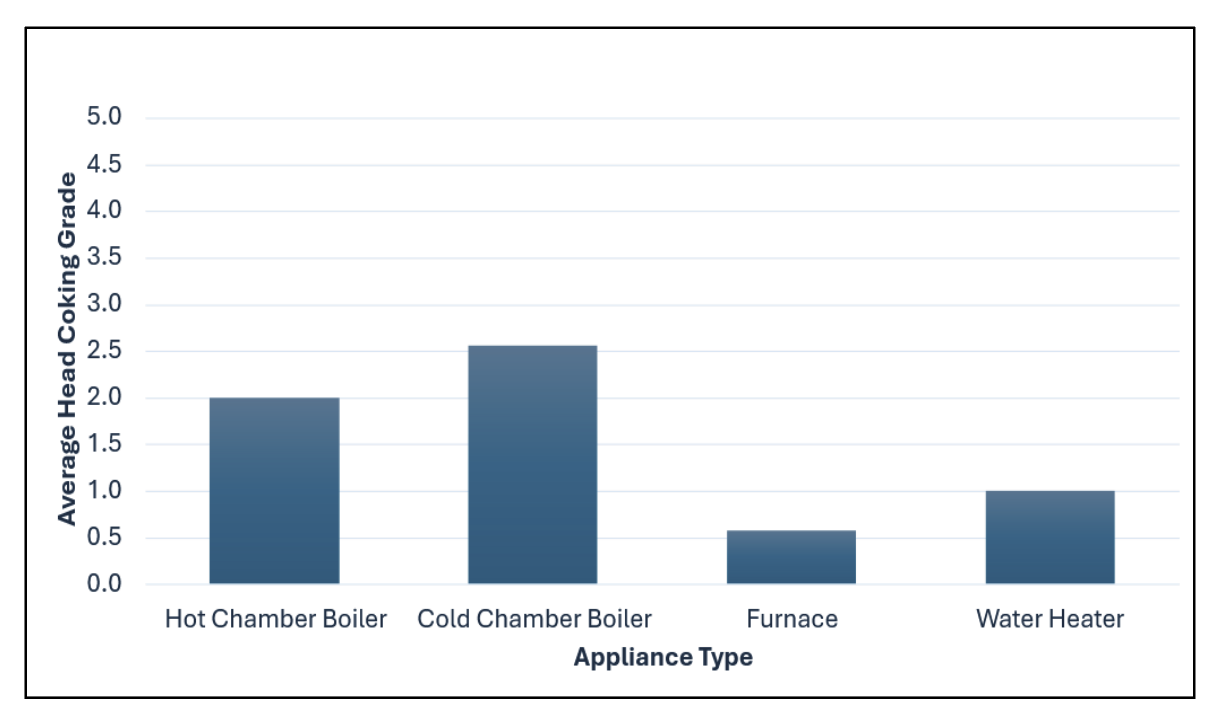
NORA created a visual numerical scale to evaluate burner head coking. Higher rates of head coking were found in “cold chamber” appliances, which have no refractory lining in the combustion chamber. With “hot chamber” appliances, those with a refractory lining, nominal head coking was observed. If burners are serviced in accordance with manufacturers’ instructions, no long-term head coking concern is expected.
Finding the Properties
The field study aimed to obtain approximately 150 sites that would represent a wide range of conditions and heating system types in the field. Seven liquid heating marketers in Pennsylvania and three in Massachusetts agreed to participate and identify suitable locations. Sites were selected based on factors such as customer willingness, accessibility, and delivery efficiency. Sites with outside tanks were excluded as the effects of outside storage conditions on the test fuels were not within the scope of the project.
A total of 178 site entries were received from the liquid heating marketers. One liquid heating marketer in each participating state withdrew for logistical reasons, eliminating forty-eight sites. Several other sites were removed before or during the study because the storage tanks were outside, the site occupants moved, or a liquid heating marketer discontinued use of a facility building that was included in the study.
Finally, 121 sites were chosen to use a 100% renewable liquid fuel: either RD80/B20 or RD50/ B50. Of these, eighty-four sites (69%) were located in Pennsylvania, and thirty-seven sites (31%) were located in Massachusetts. It must be noted that the seven standalone water heaters were considered as sites, but not as independent locations since they were collocated with a heating appliance. The final 121 sites were spread across 114 independent locations.
Appliances and Fuel Tanks
The site appliances consisted of boilers, furnaces, and standalone water heaters representing twenty-eight different manufacturers.
Boilers account for most of the appliances in both states. They represent a nearly identical percentage of appliances in both states, similar to their distribution across all sites. Furnaces make up a larger proportion of sites in PA than they do in MA. This is consistent with anecdotal information on appliance usage within the two states. Water heaters, on the other hand, are represented to a greater degree in MA than in PA.
Burners manufactured by three companies are represented by the ninety sites for which the burner manufacturer is known. For the remaining thirty-one sites, the liquid heating marketers were unable to acquire that information.
Appliances and burners were not replaced for the study as the goal was to evaluate the fuels in existing heating systems. In a widespread transition to these fuels, most equipment would remain unchanged, making this a practical, real-world approach. There were, however, thirteen sites where old and/or faulty appliances (12 boilers, one furnace, each with a new burner) were replaced within three years prior to the study. Separate burner-only replacements were performed at two sites during the same period.
The age range of the fuel storage tanks was provided by the liquid heating marketers for sixty-seven of the 114 locations. Liquid heating marketers were asked to select one of three age groups: 1-5 years, 6-20 years, and greater than 20 years. Tank ages were unknown at the remaining locations because the respective marketers had not installed the tanks, delivered fuel but did not provide contracted service, or otherwise could not determine the tanks’ ages.
Given the age of many fuel storage tanks, several were expected to contain water, degraded fuel, bacterial growth, or other contaminants that could reduce fuel quality. Despite this, the tanks were not cleaned, emptied, or replaced at any of the sites in preparation for the test as it is unlikely that such a measure would be taken in the case of widespread adoption of this new fuel. At one site, the research team recommended a tank replacement because of high amounts of biological growth found during the pre-test fuel analysis. During the test, an approximately 50-year-old tank was replaced by the homeowner as a precaution. There were also seven sites where the fuel tanks were replaced within three years prior to the beginning of the study.
Service, Fuels, and Delivery Data
For the purposes of the study, “service” was defined as any time a heating technician visited a site for any reason, including a “no-heat call” or general troubleshooting. Yearly maintenance visits were excluded from the analysis unless an issue outside the parameters of a tune-up was uncovered during the tune-up. The fuel marketers provided NORA with three years of service history for each site as well as ongoing data from any service performed during the study. The information provided for each serve call included the reason for the visit, any changes made, and whether the issue was resolved.
The historical data was used to identify sites with recurring issues as well as to compare the service requirements during the study to characterize any operational changes which may have been related to the test fuel. If a service call was suspected to be fuel related, the research team interviewed the technicians and, when necessary, performed further analysis of any defective part.
All fuel for this testing was supplied by Chevron and sold to the liquid heating marketers at price parity with heating oil. The liquid heating marketers were responsible for handling delivery logistics to their respective sites. In all cases, the liquid heating marketer reserved a truck to exclusively manage and deliver the test fuels to avoid mixing with non-test fuels. These trucks were refilled from one of three regional locations.
- Northeast Massachusetts – separate shipments of RD and BD; each heating marketer used a different blend of the two fuels. Fuels were blended at the storage facility.
- South Central Pennsylvania – RD80/B20
- Southeast Pennsylvania – RD80/B20
Fuels were delivered to and blended at Broco Energy in Massachusetts at either RD80/B20 or RD50/B50 blend levels. The Pennsylvania fuels were delivered blended to a transload facility in Strasburg, PA, where it was transferred by
Oehlert Bros., Inc. and Rhoads Energy Corporation to their respective storage facilities. Regional fuel marketers picked up the fuel from their applicable facility.
Level 1 and Level 2 Sites
Visiting all the test sites for detailed inspections and fuel sampling on a periodic basis was not seen as feasible. Therefore, a select number of sites were chosen for detailed field monitoring in conjunction with service data tracking. These sites were designated as Level 1. The remaining sites were designated as Level 2 and would be analyzed using service data.
Four liquid heating marketers opted to select 13 Level 1 sites, all utilizing boilers. As it was important to capture the performance of the fuel in furnaces and water heaters to ensure this study reflected the wide diversity of heating appliance types in this market, an additional 15 sites were classified as Level 1 locations. Further consideration was given to ensure that
the three most common burner manufacturers were adequately represented. Single-pass or pin-type boilers with refractory-lined combustion chambers are classified as ‘hot chamber’ boilers, while triple pass boilers are classified as ‘cold chamber’ boilers. Furnaces and water heaters are considered ‘hot chamber’ appliances.
Out of the 28 Level 1 sites, 11 (39%) were in MA and the remaining 17 (61%) were in PA. The sites were mostly homes, with two office buildings and two college buildings included in the list. The appliance category was made up of boilers, furnaces, and water heaters, manufactured by fourteen companies.
The research team performed five planned data and fuel collection visits to each of the Level 1 sites between October 2024 and May 2026. During the Visit 5 period (Spring 2026), nineteen Level 2 sites were also visited. All visits were made by at least one member of the NORA team accompanied by personnel representing the liquid heating marketers (e.g., service technician, service manager, owner, etc.).
Results
Service calls: In the three-year period prior to the study, 80 service calls were recorded; 22.5% were determined to be fuel/fuel system related. In contrast, 56 service calls were recorded during the study, of which 26.8% were fuel/fuel system related. Applying this normalization approach on a site-by-site basis shows an increase in the rate of fuel/fuel system
related service calls for thirteen sites and
a decrease at ten sites during the study period. The remaining sixty-six sites did not experience any change.
- Fuel-pump failures caused four service calls: two at Site 8 (Level 1), one at Site 9 (Level 1), and one at Site 80 (Level 2). The service technician replaced only the fuel pump in all four cases.
- There were four service calls due to failed nozzles, occurring twice at Site 22 and once each at Sites 44 and 46.
- Blocked filters caused two service calls, once each at Sites 19 and 88. In both cases, the filter element and nozzle were replaced.
- Carbon buildup on the nozzle caused improper atomization at Site 120. This was resolved by replacing the nozzle and cleaning the nozzle assembly.
- Flue gas O2 and CO2 remained within burner manufacturers’ recommended specifications throughout the study period for most sites.
Biodiesel Content: Biodiesel concentrations showed considerable variability across sampling locations before the introduction of the RD/BD blend fuel. Initial measurements (Visit 1) showed a wide distribution ranging from 0 to 100% v/v, with many of the sites located in Pennsylvania starting with 0% biodiesel. At the other end of the spectrum, Sites 1 through 4 started the test with nearly 100% biodiesel in their fuel storage tanks.
After the delivery of the test fuel between Visits 1 and 2, the biodiesel content of most sites began to reach the desired levels (B50 for Sites 1–6, B20 for Sites 7–28). As more fuel deliveries were made throughout the test period, subsequent sampling (Visits 2–5) demonstrated more consistent biodiesel concentrations.
Oxidative stability, as measured by Rancimat induction time, varied across sites and visits. Mean induction times ranged from 6.8 to 13.7 hours across the five sampling events. Compliance with ASTM D396 varied across visits. The majority of samples measured for all visits met or exceeded the 6-hour requirement, indicating generally acceptable oxidative stability.
Total Acid Number: Overall, testing demonstrated that the majority of samples did not exceed the 0.3 mg KOH/g limit set by ASTM D396. Most sites demonstrated no excess acidity during any collection period. In the case of the sites that did experience elevated acid numbers, the elevated acid numbers may be linked to site-specific conditions.
Bound water content: While most sites had low measured water content, a few sites had elevated levels for most of the testing period. The presence of high outliers suggests that water contamination may be specific to particular locations rather than uniform across all study sites.
Water and sediment levels: While a number of sites showed elevated levels of water and sediment, much of this appears to be because of the preexisting conditions in the storage tanks.
Biological contamination: The cATP results indicate that microbial growth was not widespread across the monitored renewable diesel and biodiesel blend storage systems but was instead localized to a limited number of tanks. Site-specific storage conditions appear to have been the primary drivers of microbial contamination, with many of these conditions already present before the introduction of the new fuel blends. This pattern is consistent with microbial proliferation occurring only when favorable conditions, such as the presence of free water, are present.
Density: Fuel density varied among the sampling events, reflecting changes in blend composition throughout the field study. Visits 3 and 5 exhibited narrower distributions of densities, indicating more consistent fuel blending across sampling locations. The minor increase in average density observed between Visits 3 and 5 corresponds to the slight fluctuation in biodiesel content found during Visit 5. This could point to the slight incorrect blending levels of the final RD/BD blend or the possible contamination of the fuel systems with small amounts of No. 2 heating oil. Overall, these measurements support the observed transition toward more uniform RD/BD blends over the course of the field evaluation.
Viscosity: Kinematic viscosity increased modestly throughout the field study, reflecting changes in fuel composition over time. The data demonstrate that, while viscosity increased modestly over time, all measured values remained within the range expected for renewable diesel–biodiesel blends suitable for residential heating applications.
Head Coking: The progression of head coking was documented for each Level 1 site, capturing retention head pictures and noting the consistency of the deposits. While an attempt was made to capture an image of the retention head at every visit, it was not possible in some cases for burners with fixed retention heads. However, all head conditions were captured during Visit 5, including those at the nineteen Level 2 sites. The sites are grouped by appliance type and generalized combustion chamber configuration, as described below:
- Hot chamber boilers: These are typically known as single pass boilers with refractory material present that retains and reflects heat in the combustion chamber
- Cold chamber boilers: Otherwise known as triple-pass boilers with little to no refractory material which causes the combustion chambers to be cooler than the other appliance types listed
- Furnaces: Refractory material forms the entire combustion chamber in furnaces and, hence, the chamber temperatures are some of the hottest compared to other appliance types
- Water heaters: Standalone water heaters are also known to have very hot chambers as the lining is entirely made of refractory material
The average of all head coking grades from Visit 5 was calculated for each appliance type. The comparison is shown in the chart at right.
Summary and Conclusions
This field study followed a bold plan to include a very wide range of heating appliance types and neither emptied nor cleaned the fuel tanks prior to the start of delivery of the test fuels. Many of the systems have been in place for more than 20 years. The project team felt this approach was an important reflection of what a realistic widespread adoption would be. Liquid heating marketers typically do not have the capability to economically deliver different fuels to segmented parts of their customer base. Conversion of heating systems and/or emptying and cleaning tanks before the transition is simply unrealistic.
Even under these challenging conditions, none of the sites experienced problems with ignition, steady-state combustion, fuel-system leaks, or chimney blockages.
The summer shutdown period also seems to be the most vulnerable period for the fuel blends, as it is with typical No. 2 heating oil. Sites 6 (RD50/B50) and 9 (RD80/B20) both showed a large decrease in oxidative stability between Visits 2 and 3. Site 9 also experienced a large increase in the measured total acid number during this same period. However, in both cases, the oxidative reserve and acid number values came into line with the ASTM D396 standards by Visit 4. This may highlight the improvement that occurs in a fuel system when it receives fresh fuel during the heating season.
This eighteen-month field study demonstrates that 100% renewable liquid fuel blends consisting of RD50/B50 and RD80/B20 can be successfully used in a broad cross-section of existing residential and light commercial oil-fired heating appliances, with few or no system modifications.
Across 121 boilers, furnaces, and water heaters, combustion performance remained within manufacturers’ specifications after the switch from conventional heating oil with three exceptions, even though the tanks were not cleaned and the burners were neither replaced nor retuned beforehand. Approximately 16% of the sites utilized RD50/B50, and the remaining sites used RD80/B20. For this reason, the conclusions are weighted towards RD80/B20 results.
The study confirms that storage tank condition remains a more significant determinant of long-term fuel quality than fuel composition itself. Importantly, the occurrence of water, sediment, and microbial contamination was not uniformly distributed across the study population. Instead, these issues were concentrated at specific locations and often persisted throughout multiple sampling events. Elevated water, sediment, and biological contamination were associated with legacy storage issues rather than the RD/BD blends, reinforcing the importance of established tank maintenance practices regardless of the fuel used. Storage tank condition remains the dominant factor governing long-term fuel quality performance.
The findings support widespread adoption of these renewable fuels as a technically viable pathway toward substantial greenhouse gas reductions without requiring extensive replacement of heating appliances or costly system-wide changes for customers. Continued emphasis on proper storage tank maintenance, routine burner service, and use of modern burner controls will further support reliable long-term operation as adoption of 100% renewable liquid heating fuels expands.
Source: Conversion of Oil-Fired Heating Systems to 100% Renewable Fuel, National Oilheat Research Alliance, August 2026, Butcher, Islam, and Kerr © 2026

