

Online DTW notification is a simple and relatively inexpensive way to further protect company resources.
Any company that distributes propane is required to provide annual safety information to all of its customers, and send those notices twice a year for jurisdictional system accounts.
Most companies comply with this obligation by mailing out the Propane Council’s Propane Safety Brochure. This can be very time consuming when done in-house. Many businesses turn to a third-party, like PriMedia, to manage the mailing and provide a U.S. Postal Service Certificate of Mailing to prove compliance.
Those certificates prove that the item was mailed. This has often provided propane retailers with the protection needed against excessive law suits should the worst occur, and a consumer suffers damage due to their propane use. If the company has provided the safety information, and the consumer was using their fuel in an unsafe manner, the company might not be found liable. Several jury trials have ended with the propane retailer absolved of any financial responsibility.
There is, however, a risk, as the mailing certificates might show the intent to provide the customer with the warning, but they do not prove that the materials were read by the consumer. Integrating your DTW notifications with your online portal can mitigate some of that risk.
Digital Safety Notices
Supplementing a company’s DTW mailings by adding an integrated DTW application to its online portal is a simple and relatively inexpensive way to add a level of protection against charges of noncompliance or unfounded lawsuits.
The customer portal is already pulling account data from the enterprise software, which will enable it to provide an online safety notice to all propane customers while excluding those who only purchase heating oil or other liquid fuels or services.
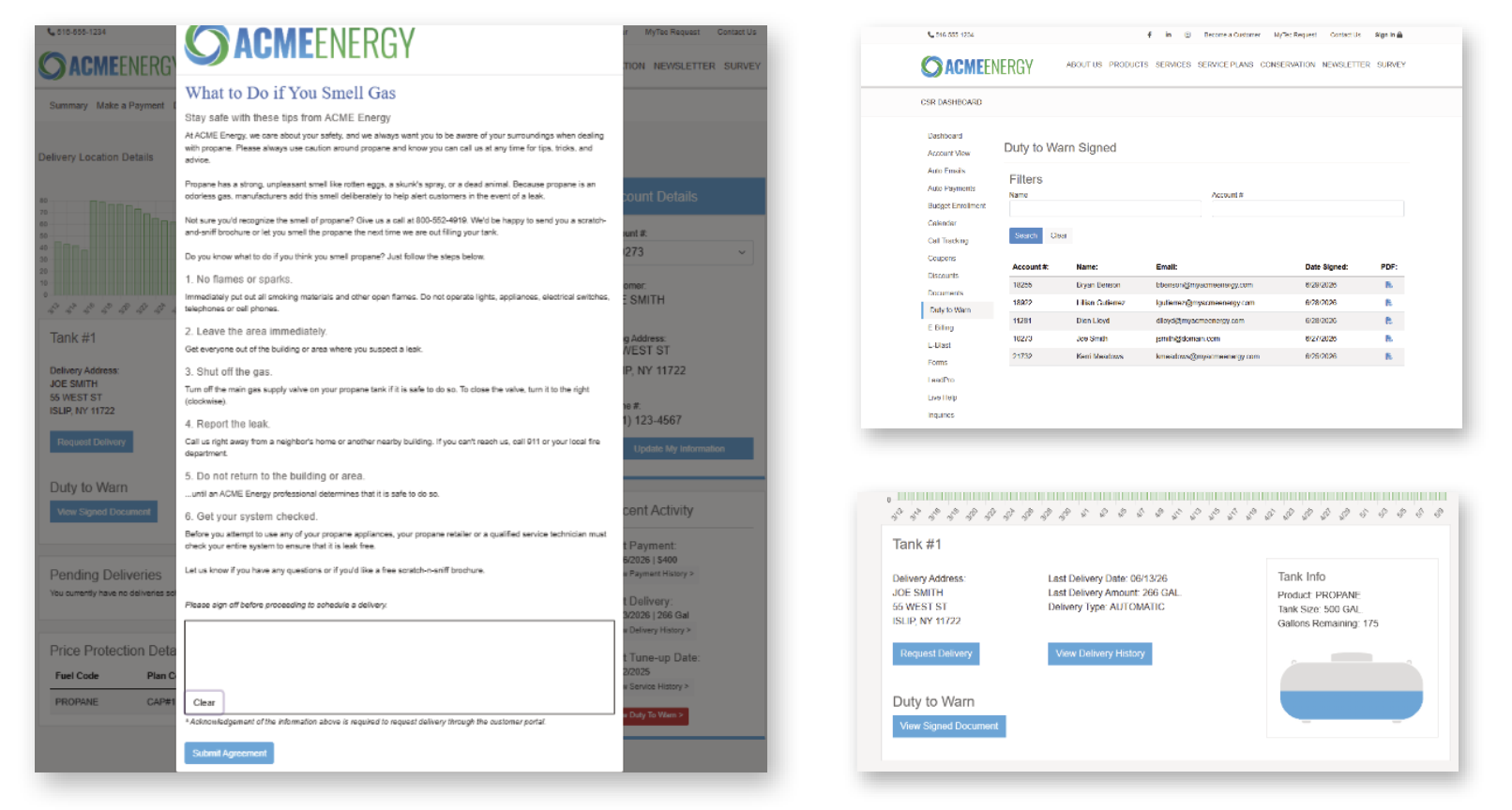
Once the integrated DTW is in place, propane customers accessing the portal will be served a “What to do if you smell gas” safety warning, using the information provided by the Propane Energy Research Council (PERC).
The user will not be able to bypass this screen. They will be required to digitally sign and submit the notice, which will then be archived and accessible to both the company and the customer.
If DTW service were ever to be questioned, the company would be able to retrieve the customer’s signed Safety Notice as proof of delivery.
A “Duty to Warn” status will also appear on the customer’s dashboard, showing that their notice has been signed, and making a PDF of the document available for review and download as needed.
This is also a perennial application. The system will automatically serve the pop-up to each customer as they approach the anniversary of their last signing.
Readers may have noticed the one missing piece in this system: the “scratch and sniff” warning brochure.
Computer technology has not yet advanced to the point of transmitting scents through the digital cloud. Until it does, digital duty to warn notifications must be used as an adjunct to the traditional mail notifications.
DTW Mailings Done Right
Small propane retailers often think that they are best served by handling their duty to warn mailings on their own. However, they are discounting the hours this decision takes away from their business operations.
No matter how large or small a company is, preparing a customer-wide duty to warn mailing will include:
- Reviewing and organizing the company mail list
- Ordering the brochures from PERC
- Multiple days (or hourly equivalent) of drafting and printing out boilerplate cover letters, printing envelopes or mailing labels, collating the brochures with the letters, sealing each envelope, and running each envelope through the postage meter
- Sending a staff member (or members) to the post office to deliver letters and wait for a Certificate of Mailing
- Securely filing and archiving the mail list, letter files, and Certificate of Mailing
When all is calculated, the cost to use a professional marketing partner to complete the mailing can be far less than just the cost in employee hours.
Let’s now consider a large company with around 30 different locations across several states, many with unique legacy company names, and counting between 2,000 and 30,000 customers at each. In addition to the two PERC brochures the parent company needs to include in each mailing, some locations require state-specific safety brochures as well.
The most efficient way to manage a mailing of this size and complexity is to outsource it to a firm specializing in this type of project. The detailed oversight requires managing each location as its own project while coordinating the materials, printing, and mailing with mail-service provider partners to ensure that the mailings go out on time, and that accurate reporting and Certificates of Mailing are received and forwarded in a timely manner.
Why You Need a Portal
A customer self-service portal is much more than a pay online service or a place to put a Propane Safety announcement. A company without a self-service portal for its customers is losing money.
Customers of all ages expect to be able to manage their accounts online, at their own convenience: 88 percent of Baby Boomers use the internet regularly, as well as nearly all Millennials and Gen-Z; and 90 percent of consumers visit a website to get answer or solve a problem before calling.
Portals reduce incoming calls to the office, and provide the customer with 24/7 access. Because portals can be integrated directly with the company’s enterprise software, there are fewer human errors – in billing, scheduling, and customer communications. They also provide the company with additional marketing opportunities, more tracking and management of interactions, and enhanced customer satisfaction, all while increasing enrollment rates in your value-added programs.
Increase Price Protection and Budget Plan Enrollment
June, July, and August are prime time for fuel retailers to lock in customers in price protection and budget plans. While many fuel companies will allow customers to enroll in a budget plan at any time and pro-rate their payments, price protection is often time-sensitive with a hard deadline.
In light of the heightened volatility in energy markets we’re experiencing, these programs are more valuable than ever. Some companies have reported that price protection customers saved as much as $2.00 per gallon when prices spiked in March. With uncertainty at every turn, providing consumers a better way to manage their heating oil or propane costs is a smart business move, one which greatly increases customer retention rates. Making it easier for them to complete, and more secure for your company, is a win-win for you and your customers.
Online price protection and budget enrollment modules work with the customer portal and back-end software. The contracts can be developed in real time based on your pricing parameters and can include an “offer expiration date” to limit risk. Pricing can be adjusted as often as needed to meet changing market conditions, and the system will log any authorized team member who overrides the default pricing to provide a specific customer accommodation for a specified time.
Integrated price protection enrollment programs, developed specifically for liquid fuel retailers, will accommodate all
of the company’s pricing programs, including market-budget, fixed, pre-buy, capped, capped-budget, and fixed budget. They will also be able to automate pricing adjustments and discounts by contract type, gallons protected/volume, site location, veteran, or senior citizen status; add administrative or enrollment fees as a single upfront payment; adjust pricing for a per-gallon upcharge; and set contract gallon requirements: minimums, maximums, or percentage of previous year’s gallons. These agreements can be conditional, pending company management review and approval, thus providing another layer of protection for the business.
Customers will appreciate the ease with which they can complete an agreement. Once they have logged into their account, the system will automatically populate the agreement with the customer’s account information, recommended gallons, program price or estimated annual cost, and present it for the customer’s digital signature.
Similar applications enable customers to enroll in service plans online, subject to company approval and inspection of the equipment, if necessary.
While the examples above reflect services offered to residential customers, an experienced developer can adapt these modules or create new systems for commercial and wholesale providers as well.
With an integrated portal, the customer can manage more of their account and the company can provide additional services without needing to employ more service staff. Applications such as digital Duty to Warn, price protection contracts, and budget or service contract enrollments are just a few of the many money-saving and money-making options to consider.
Richard Rutigliano is President of PriMedia, Inc., an integrated marketing and communications firm specializing in the home energy sector and offering a wide array of SaaS products nationwide. He can be reached at 516-222-2041 or rrutigliano@primediany.com.

