
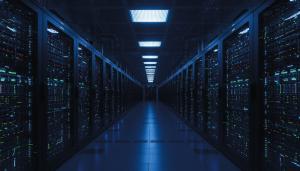
“BYOP” (Bring Your Own Power), starts with identifying available power, securing utility commitments, and building substations before construction begins.
The AI boom has led to data centers popping up in cities and towns all over the country.
There are between 4,149 and 5,427 operational data centers in the U.S. as of early 2026. Virginia remains the dominant hub with over 640 facilities, followed by Texas with about 400, and California with about 320. The U.S. now accounts for roughly 45 percent to 50 percent of all data centers worldwide.
Last year there was a huge investment surge in project development. Data center construction starts hit a record $77.7 billion in 2025 (a 190 percent year-over-year increase), with 2026 forecasted to potentially surpass this level.
This year there are almost 2800 new data centers that are planned or under construction across the country. More than 60 major projects, with a combined value exceeding $50 billion, are expected to break ground in the first half of 2026.
We are facing a serious capacity problem. While current operational power capacity is under 15 GW, there are now filings for over 150 GW of new data center power capacity nationwide. Modern AI data centers are immense, often demanding 100+ megawatts (MW) or even gigawatt-level power, which is equivalent to powering a small city.
U.S. Conference of Mayors
In early February, mayors from around the country held discussions regarding the rapid expansion of data centers at the Conference of Mayors winter meeting. Mayors who had data centers in their city for decades offered advice and shared best practices to mayors of cities considering whether a data center is a good fit for their community.
A major concern is the impact on residential electricity rates. While some grid upgrades are independent of data centers, mayors are being pressured by constituents over rising bills and the immense power demand of these facilities (sometimes equivalent to powering 750,000 homes).
In Arizona, the Mesa and Pheonix mayors have advocated for “guardrails” on development, particularly concerning water usage in arid regions.
Policies, Regulations And Zoning
What policies are mayors considering to balance both data center growth and community needs? This year, U.S. mayors are increasingly moving beyond passive tax incentives to implement more rigorous regulatory frameworks that protect local infrastructure and utility rates.
Mayors are requiring developers to secure “Will-Serve” letters from local water and electric utilities affirming they have the capacity to serve the facility without burdening existing customers.
Some local leaders are advocating for orders that force data centers to pay for their own grid and infrastructure upgrades directly, rather than passing those costs onto residential ratepayers. Other cities are reclassifying data centers as industrial facilities, restricting them to specific zones and requiring City Council approval for larger projects.
Cities are setting their own ordinances, including: establishing minimum distances between data centers and “sensitive uses” like residential neighborhoods; mandating 24-hour noise limits and architectural screening; requiring closed-loop cooling systems to drastically reduce water consumption; and setting specific timelines for data centers to reach 100 percent renewable energy use (often within five years of launching). The Sierra Club recommends requiring data centers to sign long-term contracts with steep exit fees to protect cities if a facility closes.
Power-First Data Centers
Industry analysts show growth shifting from traditional hubs to “power-first” markets. “Power-first” data centers represent a fundamental shift in infrastructure development.
Historically, developers selected land and secured power later. Power-first, or “BYOP” (Bring Your Own Power), starts with identifying available power, securing utility commitments, and building substations before constructing the facility.
Due to the massive energy demands of artificial intelligence, which are stretching existing utility grids beyond their limits, developers now prioritize power availability as the primary criterion, often designing the building around the power supply. This approach transforms data centers from real estate projects into “energy-first” ventures.
Operators are increasingly generating their own power on-site or directly partnering with energy developers to work around severe grid connection delays. By 2030, an estimated 30 percent of data center sites may use on-site power as a primary source, such as natural gas plants, fuel cells, or behind-the-meter renewables.
Site selection is moving away from traditional hubs like Northern Virginia to areas with available energy capacity or to co-location sites at existing power plant locations. In exchange for faster interconnection, “power-first” developers are partnering with utilities to act as flexible loads, reducing power consumption during peak times (demand response).
In summary, the “power-first” model treats electricity as the foundational constraint rather than a utility, forcing the industry to invest directly in energy production to ensure the future scalability of AI.
Ed and Kelly Burke are respectively Chairman of the Board and Senior Marketing Manager at fuel distributor Dennis K. Burke Inc. They can be reached at 617-884-7800 or ed.burke@burkeoil.com and kelly.burke@burkeoil.com.

